Compliance
Part of Native ad headline testing
Removing unsupported claims from native headlines
A native headline makes a claim even when phrased as a question.
A native headline makes a claim even when phrased as a question. Before publishing, identify what a reader would reasonably infer and confirm the landing page supports it.
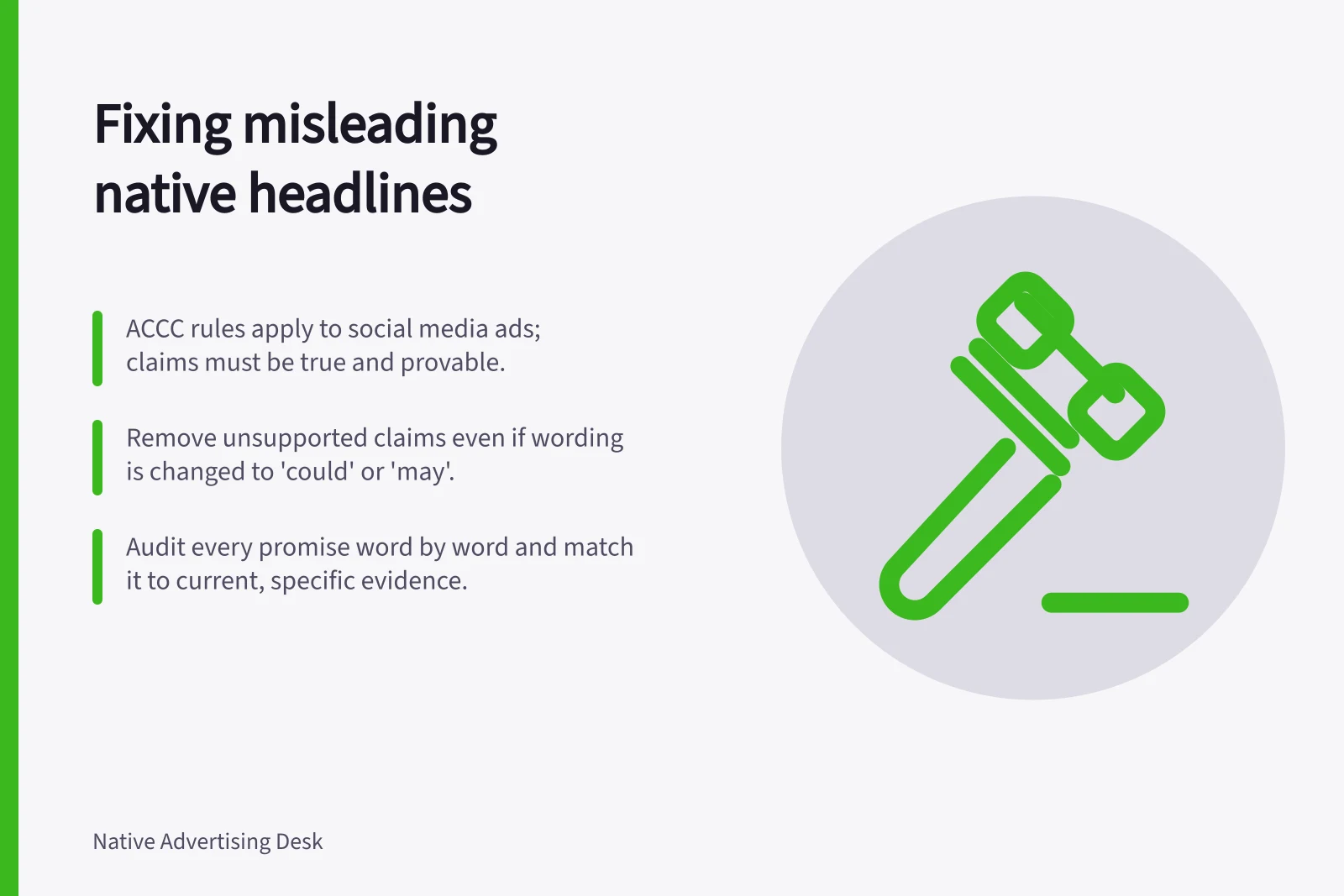
Changing “guaranteed” to “could” does not repair a headline if the central implication remains unsupported.
The ACCC says Australian Consumer Law applies to social media advertising as it does to other advertising; businesses must not make false or misleading claims. Claims should be true, accurate and based on reasonable grounds, and a business must be able to prove any claim it advertises.
Before sign-off, require the evidence file to support the headline’s full implied meaning, not just one phrase. If it cannot, remove the claim or narrow it to the supported fact.
Audit the promise word by word
Mark quantities, comparisons, superlatives, time limits and implied endorsements. Ask for a current source or internal proof for each material claim. If the evidence supports only a narrow group, name that group. If it supports a product feature but not an outcome, describe the feature rather than promising the outcome.
Match each number, comparison, superlative, deadline or endorsement to evidence for the same product, audience, outcome and period. Record the source, date and relevant passage; where the scope differs, remove the extra reach or name the narrower group the evidence covers.
A reported Slendertone advertising representation—not identified as a native headline—said it could “give the user, in 40 minutes per day, the equivalent of 300 general exercises”. The ACCC said proceedings against Emerald Ocean Distributors alleged that representation, among others, was false, misleading or deceptive.
If the evidence file cannot support that outcome, remove the time-and-exercise promise: “Slendertone product information”. That wording drops the quantified outcome rather than merely weakening it; restore no part unless evidence supports it.
Check the destination after the click. The answer should be easy to find, not buried behind a long page that never resolves the teaser. Outbrain’s guidelines prohibit content designed to deceive readers into believing something that is not true.
The ACCC can require businesses to back up claims, investigate reports and may take compliance or enforcement action. Outbrain says guideline violations may lead to removal or suspension from its network or termination of a contractual agreement; it can also reject or block content, even after launch.
Rewrite without losing interest
Replace unsupported drama with useful specificity: the audience, the decision or the concrete question the page answers. “What to check before renewing your plan” is stronger than an unverified promise that a particular trick cuts every bill. The revised line can still create interest while setting an honest expectation.
Keep a simple claim log with the headline, evidence owner, review date and landing-page location. Recheck it when the offer or underlying data changes. A claim that was once accurate can become misleading after a price, feature or eligibility update.
Keep the original claim, approved rewrite, supporting file or link, date or version, reviewer, evidence owner, review date and exact landing-page location together. Save the relevant page or data when practical so a later reviewer can see what the headline relied on.
Name an evidence owner to collect and explain the support, and a compliance reviewer to resolve gaps before publication. If support is missing, out of date or narrower than the wording, hold the headline, remove the unsupported part and record the approved wording.