Sponsored Editorial
Native ad creative and landing pages
Plan a native ad from its headline and thumbnail through to a destination that delivers the promised answer.
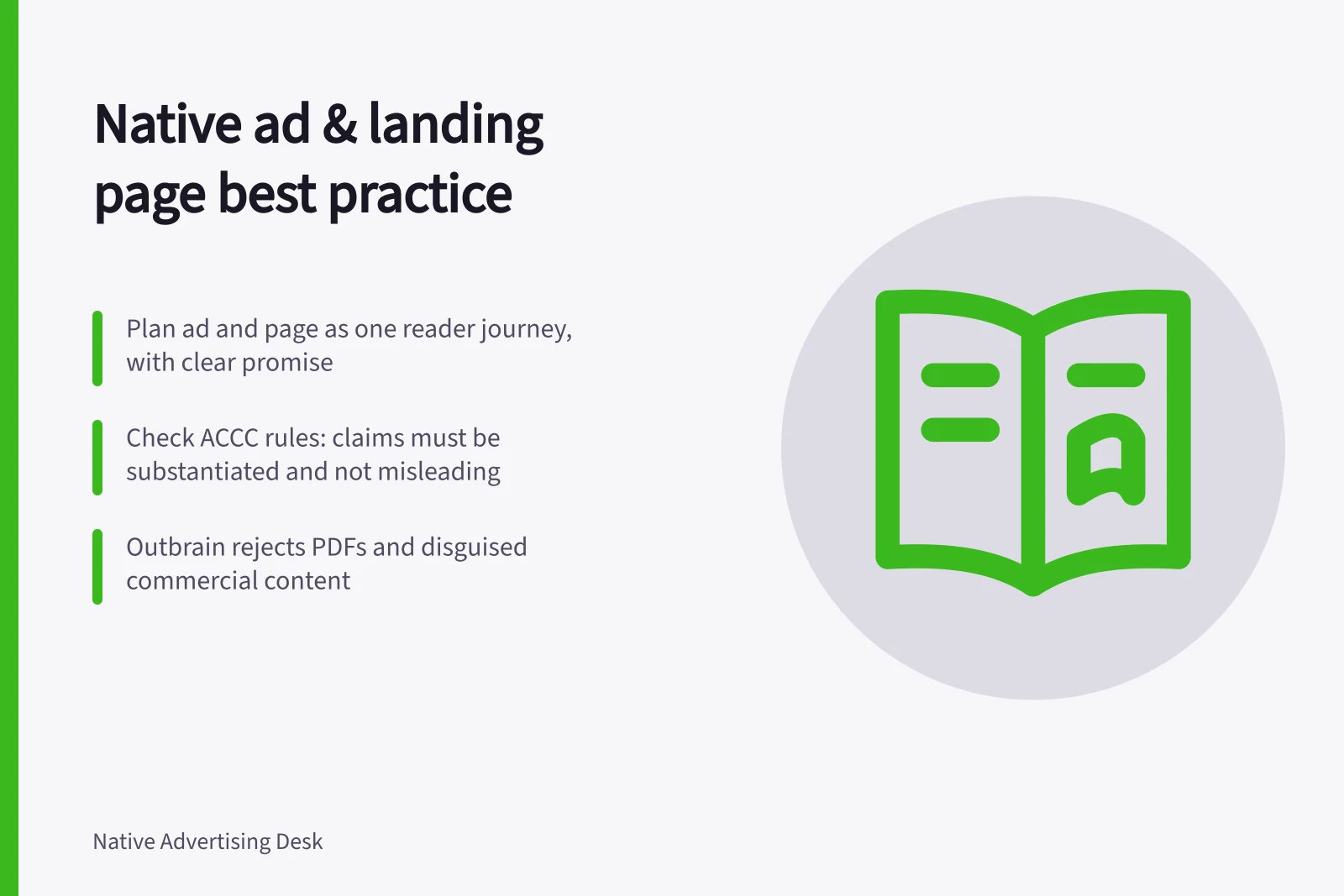
Plan the native ad and its destination as one reader journey. The headline and thumbnail set an expectation the page must fulfil. Before approving either, write down what the reader will learn.
End-to-End Native Ad Journey: From Creative to Destination
- Define the reader’s key questionWhat will the visitor understand after reading?
- Craft headline and thumbnail that reflect the answerEnsure visual and text elements align with the promised insight
- Build a landing page that delivers the promiseConfirm all claims are substantiated and disclosures are clear
- Verify compatibility with platform requirementsCheck Outbrain’s accepted formats (e.g., no PDFs, no deceptive design)
- Test the full user journey on mobilePreview card placement, load time, navigation, and next action
Set the promise
Summarise the destination in one sentence. For a hypothetical home-battery comparison article, the promise might be “questions to ask before choosing one”. A guaranteed saving is a different claim and needs evidence the article may not have.
Element / Decision to make
- Reader question
- What will the visitor understand after reading?
- Headline
- Which part of that answer can the ad promise accurately?
- Thumbnail
- What does the image imply about the subject or result?
- Destination
- Where will the promised answer appear?
- Next action
- What can an interested reader reasonably do afterwards?
Review the headline with the image. A photograph of a particular model may imply the article covers it; a dramatic scene may turn a routine explanation into an apparent warning. Check the crop in the intended placement, not just the full image.
Check the rules of the distributor and publisher you intend to use. The ACCC can require businesses to back up claims about their products or services; it accepts reports about possible misleading or false claims and uses them to inform education, compliance and enforcement work. It can investigate and may take compliance or enforcement action where a business misleads. It does not resolve individual disputes or provide legal advice.
If a claim needs qualification, ensure it limits that same claim rather than leaving a stronger impression from the headline or image.
Connect the page to the ad
Detailed reader-first landing-page structure appears in its sibling article. From creative to destination, the page should confirm the promise the ad made.
Make the commercial character clear wherever people encounter the promotion and destination. Outbrain’s accepted page types include advertorials with proper disclosure; check the applicable requirements for your format and route.
Native Ad vs. Editorial Content: Key Differences
- Commercial Character
- Clearly disclosed in native ads; hidden in editorial content
- Purpose
- Promote a product or service; inform or entertain without promotion
- Disclosure Requirement
- Mandatory (e.g., 'Sponsored' or 'Advertorial') under ACCC and AANA guidelines
- Content Value to Reader
- Must deliver genuine value; not misleading or deceptive
Choose a destination format that fits
For campaigns using Outbrain, accepted page types include article pages and blog posts, earned media, videos with descriptive text, search engine results pages, home pages, product or landing pages, app download pages, infographics and advertorials. Check the destination format fits your planned route before building creative around it.
PDF pages are not an acceptable Outbrain landing-page format. If the promised answer exists only in a PDF, that destination will not meet Outbrain’s stated compatibility standard; use an accepted page format for that route.
Outbrain’s guidelines also reject content designed to deceive readers into thinking it is legitimate editorial content or fact-based news. A promotion should not disguise its commercial character or present an advertorial with little or no value to the reader as ordinary editorial content.
Check the complete path
Preview the card in its intended placement and follow it on a phone. Check the displayed headline, image crop, page loading, opening answer, navigation and next action. For Outbrain, check current technical guidance; other distributors may set different requirements.
When checks pass, record the approved creative and destination versions so a later page change triggers another review.
Review claims and commercial presentation
Before putting a promise into a native ad, check the destination supports it and the claim can be substantiated. A headline that overstates what the page establishes creates both a mismatch and a claim risk.
Outbrain’s guidelines apply to advertisers and agency partners contracted with the Outbrain Group, and media owners using its technology agree to abide by them. Outbrain says it may reject or block content at its discretion, including after launch, if it considers the user experience compromised.
Outbrain may enforce guideline violations by removing or suspending content from its network, or terminating a contractual agreement.
Publishers and marketers can also block pages or sources they feel do not resonate with their brands. Consider whether the destination and promotion belong together for the intended placement, rather than treating platform acceptance as the only approval criterion.
Key Compliance & Platform Requirements for Native Ads in Australia
- ACCC Investigation Authority
- Yes – can investigate misleading claims and take enforcement action
- Outbrain Acceptable Formats
- Article pages, blog posts, videos, product pages, app downloads, infographics
- PDFs as Landing Pages
- Not allowed – rejected by Outbrain
- AANA Code of Ethics Enforcement
- Guides ethical advertising; supports transparency and consumer trust
In this guide
- Matching a native ad headline to the destination articleMap what a native ad headline promises to the answer readers can find in its destination article.
- Choosing a thumbnail that does not misrepresent the storyCheck what a native ad thumbnail implies, how its crop changes the card and whether it fairly previews the linked story.
- Designing a landing page for readers rather than instant buyersStructure a native ad destination so readers find the promised answer, recognise its commercial role and can take a suitable next step.