Creative Formats
Part of Native advertising for product education
Choosing proof points for a native product explanation
Select product facts, customer accounts, outcomes and comparisons that answer buyer questions and support the exact claims made.
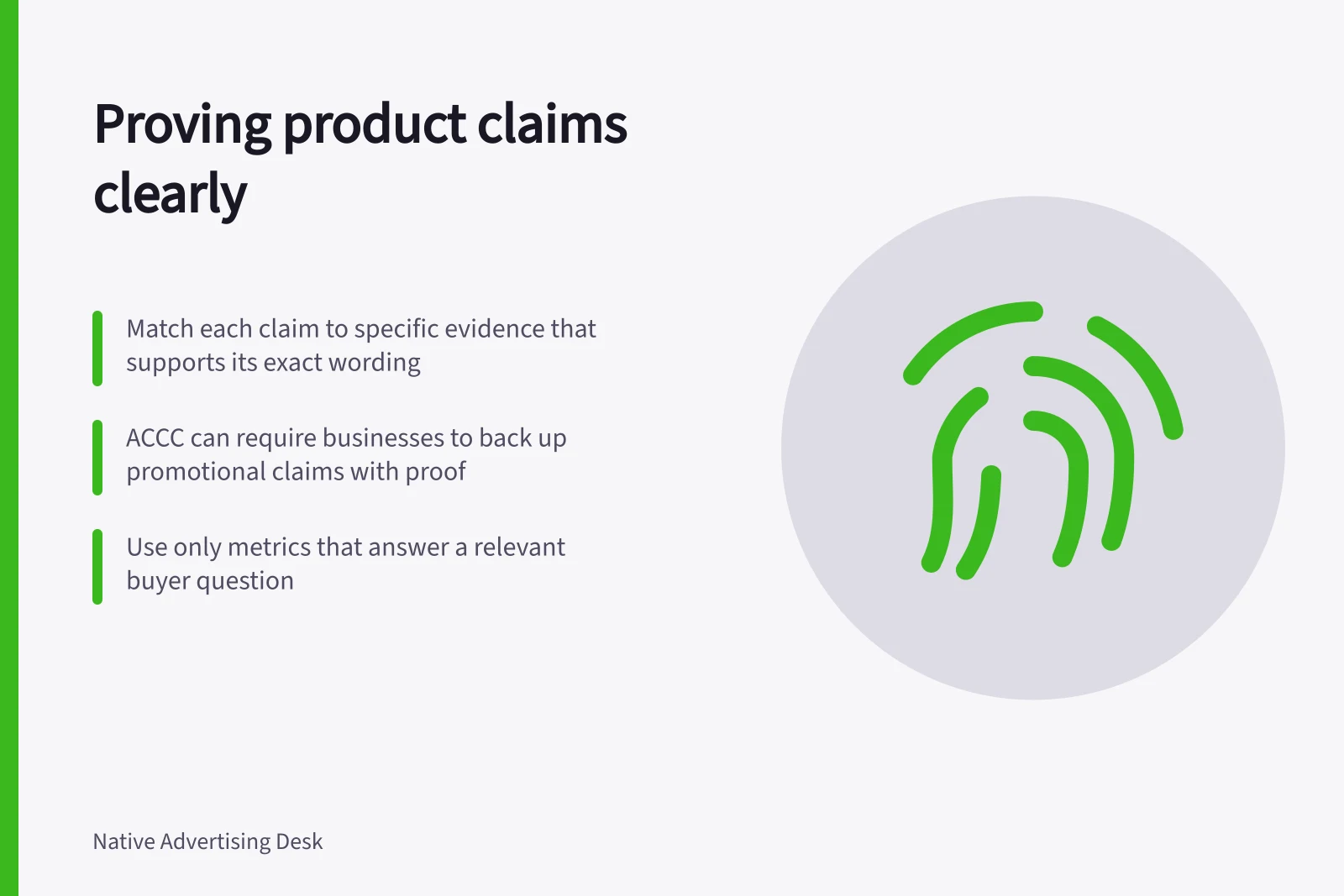
Choose proof points for the questions readers must have answered, then match each point to evidence that supports its exact wording. A specification can show what a product offers, but it cannot by itself prove a customer outcome. A testimonial describes one customer’s experience, not everyone’s likely result.
Start with the claim readers will take away
Read the proposed headline, opening, diagrams, captions and product section. Include impressions created by an image or comparison, not only literal statements. Decide which kind of support each claim needs.
| Claim | Material to examine | Limit to state |
|---|---|---|
| Product capability | Current specification or demonstration of the version described | Plan, configuration, market and required setup |
| Process | Documentation and a checked walkthrough | Steps performed by the product and by the user |
| Customer experience | Documented account and permission to use it | The customer’s setting and result |
| Measured outcome | Method, period, population and calculation | Who was measured and what the result establishes |
| Comparison | Evidence for each option under the same criteria | Versions, dates and features compared |
A short explanation may need only a few precise product facts. An outcome-led headline needs evidence for the outcome it leads readers to expect.
Fit the wording to the evidence
State a product function at the level shown by the material. A checked screen can show that a hypothetical tool exports a schedule. To claim customers save time, evidence would need to cover the amount, method and users. Otherwise, explain the export function and that it may help a buyer assess the work involved.
The ACCC says it can require businesses to back up claims about their products or services, and may investigate if a business misleads. Check the promotional card and the article body; a broad teaser can change what readers expect from narrower evidence.
Keep proof that helps the decision
A screenshot may show where an output appears. A labelled diagram may clarify a hand-off between software and a person. A documented case may illustrate use in a setting similar to the reader’s, with that setting stated. A metric earns space only if it answers a relevant buyer question.
For each proposed proof point, map reader question → claim → supporting material → material limit → article location. Narrow or remove a claim if its support falls short. Recheck the wording when the product version, offer or evidence changes.
Key Considerations for Proof Points in Australian Markets
- ACCC Regulatory RequirementBusinesses must substantiate claims; investigations may follow misleading advertising
- Australian Consumer ExpectationProof must align with actual product functionality and real-world outcomes
- Relevant Buyer QuestionDoes this solution work in my business context? (e.g., GST reporting, ABN integration)