Headline Testing
Native ad headline testing
Test native ad headlines for qualified attention, not just clicks.
Test native ad headlines for qualified attention, not just clicks. A headline can lift click-through rate by implying a surprising answer the landing page never delivers. A useful winner brings the right reader to the promised content and prompts a relevant next action without overstating the claim.
Begin with a truthful promise
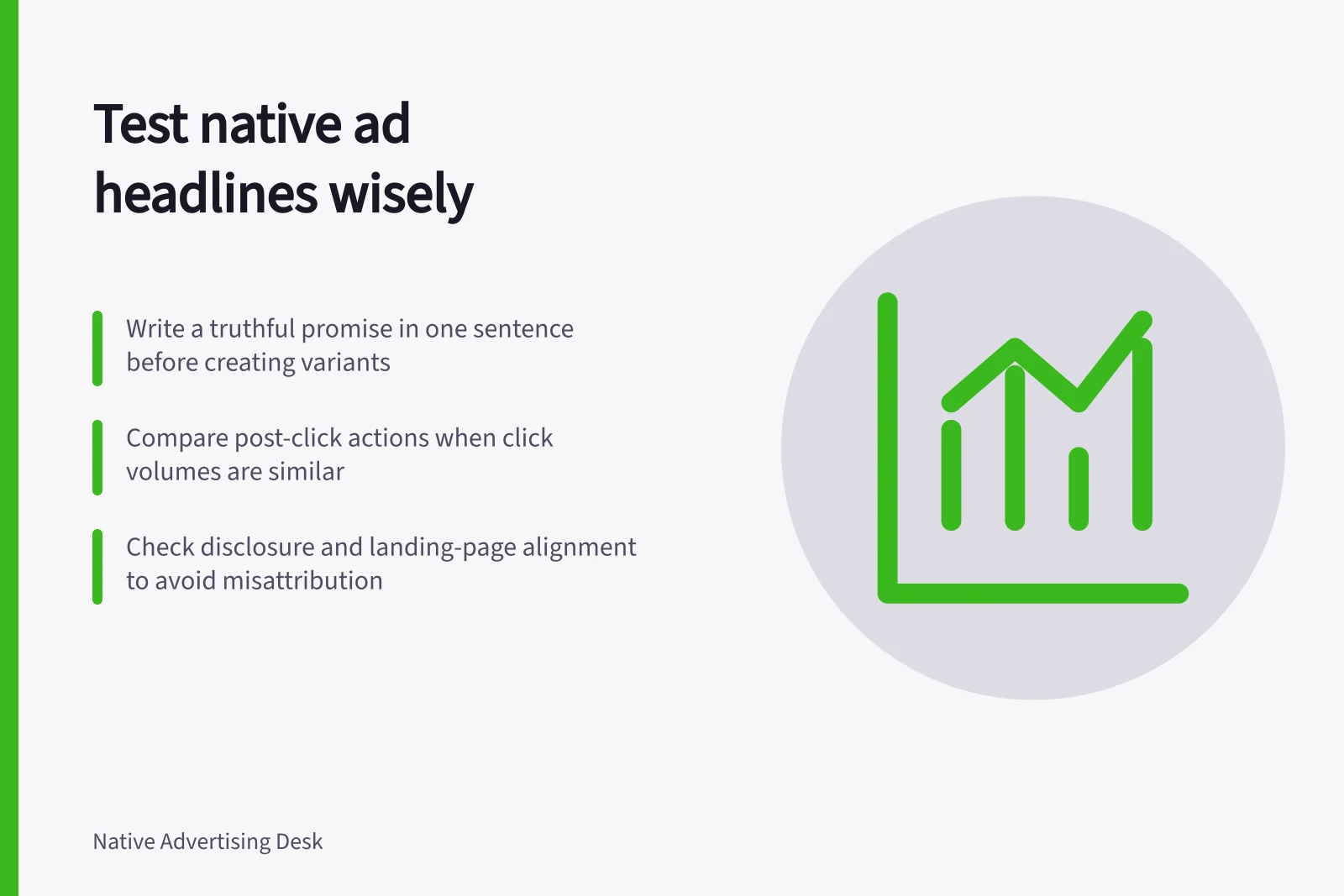
Write the landing page's actual answer in one sentence. Then create headline variations that change how that answer is framed: an informative version, a question version or a benefit-led version. Each must remain accurate when read without the image or source name. Avoid invented urgency, unsupported numbers and “one weird trick” phrasing that promises more than the page delivers.
Outbrain's guidelines prohibit content designed to deceive readers into believing they are reading legitimate editorial content, and require proper disclosure for advertorials. Check the applicable platform and local rules for the campaign market.
Make the comparison interpretable
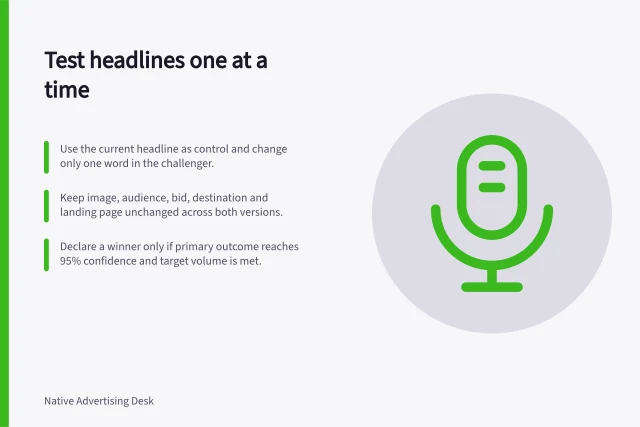
Keep image, landing page, audience, bid approach and flight as stable as the platform permits. If several elements change together, the result cannot be attributed to the headline alone. Give variants enough eligible exposure to avoid choosing a winner from a few clicks, but do not use a universal numerical threshold without considering volume and business risk.
| Metric | What it answers | What it misses |
|---|---|---|
| Click-through rate | Which version attracted a click | Whether the expectation was fulfilled |
| Engaged landing visit | Whether readers reached and used the page | Later business value |
| Relevant action | Whether the visit advanced the goal | Longer-term effects outside the window |
A curiosity-led version with more clicks but much weaker post-click engagement may be attracting the wrong audience. Check page speed and tracking before drawing that conclusion.
Separate headline response from placement clarity
A headline test does not, by itself, show whether people understood that a placement was advertising. IAB Australia’s native advertising webinar recommends checking the placement and its disclosure when readers appear to mistake an ad for editorial content.
Bounce rate or weak lower-funnel conversion can be signs of poor traffic quality, but they do not identify the cause on their own. The webinar recommends checking disclosure first, then offer and landing-page alignment; if both are strong but results remain poor, consider whether audience targeting is the issue.
A claim can be supportable yet still create an expectation that the offer or page does not fulfil; that mismatch can undermine traffic quality even when the headline attracts clicks.
Include publisher and reader fit
A headline’s fit depends partly on where it appears and what readers expect from that publisher. In the IAB Australia webinar, Pedestrian.TV’s Group Native Content Manager described trust and understanding what a publisher stands for, and what its readers look to it to provide, as important to brand and audience engagement.
A version that performs well in one publisher context may not be a sound choice elsewhere. When comparing results across placements, consider whether the publisher’s audience and editorial expectations are comparable before treating the difference as evidence that one headline is generally stronger.
Keep the goal broader than reach alone: the webinar describes the shared aim as reach, engagement and positive association. A headline that attracts attention but sits poorly with the publisher’s audience may not meet that broader objective.
Use the next action as a tie-breaker
When headline variants attract similar click volume, compare the relevant post-click actions against the campaign objective instead of choosing on click-through rate alone.
Check destination and platform fit
The destination format is another condition to account for when judging a headline. Outbrain lists article pages and blog posts, earned media, videos with descriptive text, search engine results pages, home pages, product or landing pages, app download pages and infographics among its acceptable page types.
Outbrain says advertorials need proper disclosure in line with its Advertorial policies, and that PDF pages are not acceptable landing page formats. These distinctions matter when a headline test sends readers to different kinds of destinations: a result may reflect the destination’s suitability as well as the wording.
Outbrain says it may reject or block content at its discretion, including after launch, and lists removal or suspension from its network or termination of a contractual agreement as possible enforcement. Treat platform eligibility as a boundary for test choices, not as a performance metric.
Outbrain's Acceptable Landing Page Formats
- Article pages
- Accepted
- Blog posts
- Accepted
- Earned media
- Accepted
- Videos with descriptive text
- Accepted
- Search engine results pages
- Accepted
- PDF pages
- Not accepted
Keep a claim record
For detailed guidance on keeping a claim record, see the supporting article.
In this guide
- Comparing informative headlines with curiosity-led variantsAn informative native headline tells readers what they will learn or get.
- Removing unsupported claims from native headlinesA native headline makes a claim even when phrased as a question.
- Testing one headline change at a timeTo learn what a native headline changed, keep the rest of the creative and delivery as stable as possible.
- Detecting clickbait that damages post-click engagementClickbait becomes an operational problem when a headline attracts a click by setting an expectation the destination does not meet.