Headline Testing
Part of Native ad headline testing
Testing one headline change at a time
To learn what a native headline changed, keep the rest of the creative and delivery as stable as possible.
To learn what a native headline change did, keep the rest of the creative and delivery as stable as possible. If image, audience, bid and destination all move together, the result is a campaign comparison, not a headline test.
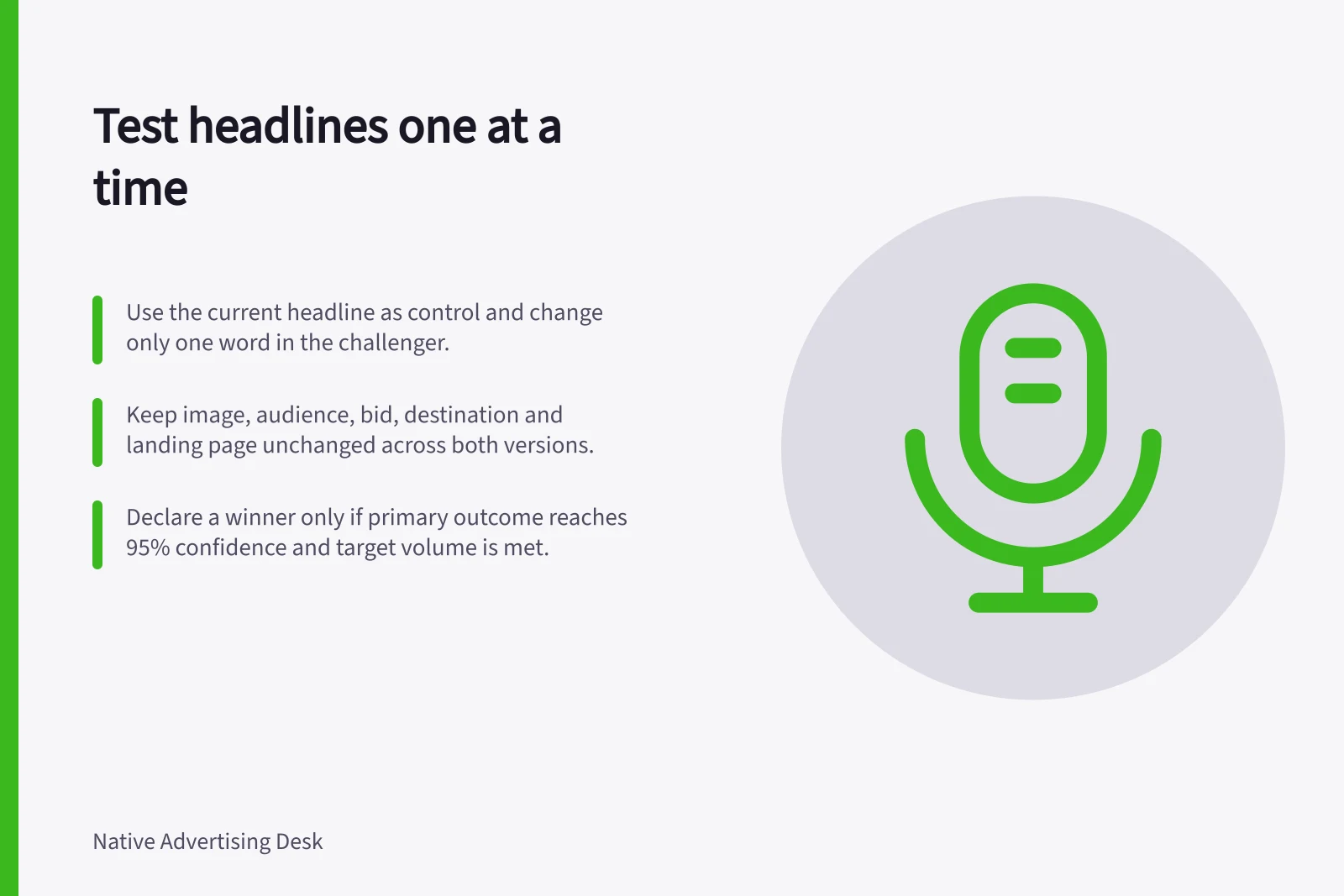
Worked setup: use the current headline as the control and a challenger with one planned wording change. Keep the image, body copy, audience, bid, placement, destination, landing page and dates fixed so that change is the only variable.
If the network permits an even split, assign 50% of traffic to each version. Record the allocation and run both versions over the same flight.
State the hypothesis
Write a specific prediction: “Naming the decision in the headline will bring fewer casual clicks but more engaged readers than a broad question.” Choose one primary outcome before launch. CTR is useful for attraction; a qualified landing action is better when the goal is useful traffic. Keep secondary metrics visible so a lift in one measure does not hide damage in another.
Define the primary outcome as a measurable event, such as CTR or a qualified landing action like a form submission, purchase, signup or booking. Use the same outcome definition for both versions, and do not change the primary metric after seeing early results.
Use matched placement and time conditions where the platform permits. Random or balanced allocation is preferable to running version A in one week and B in another with different news cycles. Confirm the experiment controls of the actual native network rather than assuming they are identical.
On Taboola, Outbrain or MGID, check the experiment controls available in the account before launch. Verify the allocation, audience, placement and dates rather than assuming the settings are the same across networks.
Key Metrics for Headline Testing
- Primary Outcome
- CTR or qualified landing action (e.g., signup, purchase, booking)
- Minimum Useful Volume
- Hundreds to thousands of visitors depending on conversion rate
Decide with uncertainty in view
Set the flight and minimum useful volume in advance based on expected traffic. Do not stop at the first favourable day. Check whether the audience mix and landing-page load were comparable. If the result is close or the sample is small, record “inconclusive” and refine the next test instead of declaring a winner.
Plan for hundreds or thousands of visitors, depending on your current conversion rate; treat this as broad planning context, not a fixed minimum for every native campaign. Set the target and flight dates before launch, then run both versions at the same time until the target is reached.
Where your reporting supports a confidence estimate, call a winner only if the primary outcome reaches 95% confidence or higher and the planned volume has been met. If that threshold is not met, or the result is close or the sample is small, record “inconclusive”.
Save both headlines, the unchanged elements, dates, audience and outcome definition. That record makes the next iteration faster and prevents a later team from repeating a weak test under a new name.