Sponsored Editorial
Part of Sponsored article production
Building a fact-checking brief for sponsored content
Build a claim-by-claim fact-checking brief with exact wording, evidence, dates, material conditions and a decision for the writer.
Build the fact-checking brief from the claims in the proposed article, not just the documents the sponsor supplies. Give the checker the exact wording, the evidence offered for it and any limit readers need to know. A folder of documents does not show which sentence each document supports.
Capture the claims readers will see
Read the draft headline, standfirst, body, captions, teaser and call to action. Record every checkable assertion and any material implication created by an image or comparison. A sponsor's opinion can be attributed as a perspective, but a measurable assertion within it still needs checking.
Use one row per claim:
Field / Record
- Wording and location
- The exact statement or presentation under review
- Claim type
- Product fact, price, availability, comparison, outcome or wider context
- Evidence and owner
- The source, who supplied it and who can explain it
- Date and scope
- The product version, Australian market, period or customer group covered
- Material conditions
- Exceptions or assumptions readers need beside the claim
- Decision
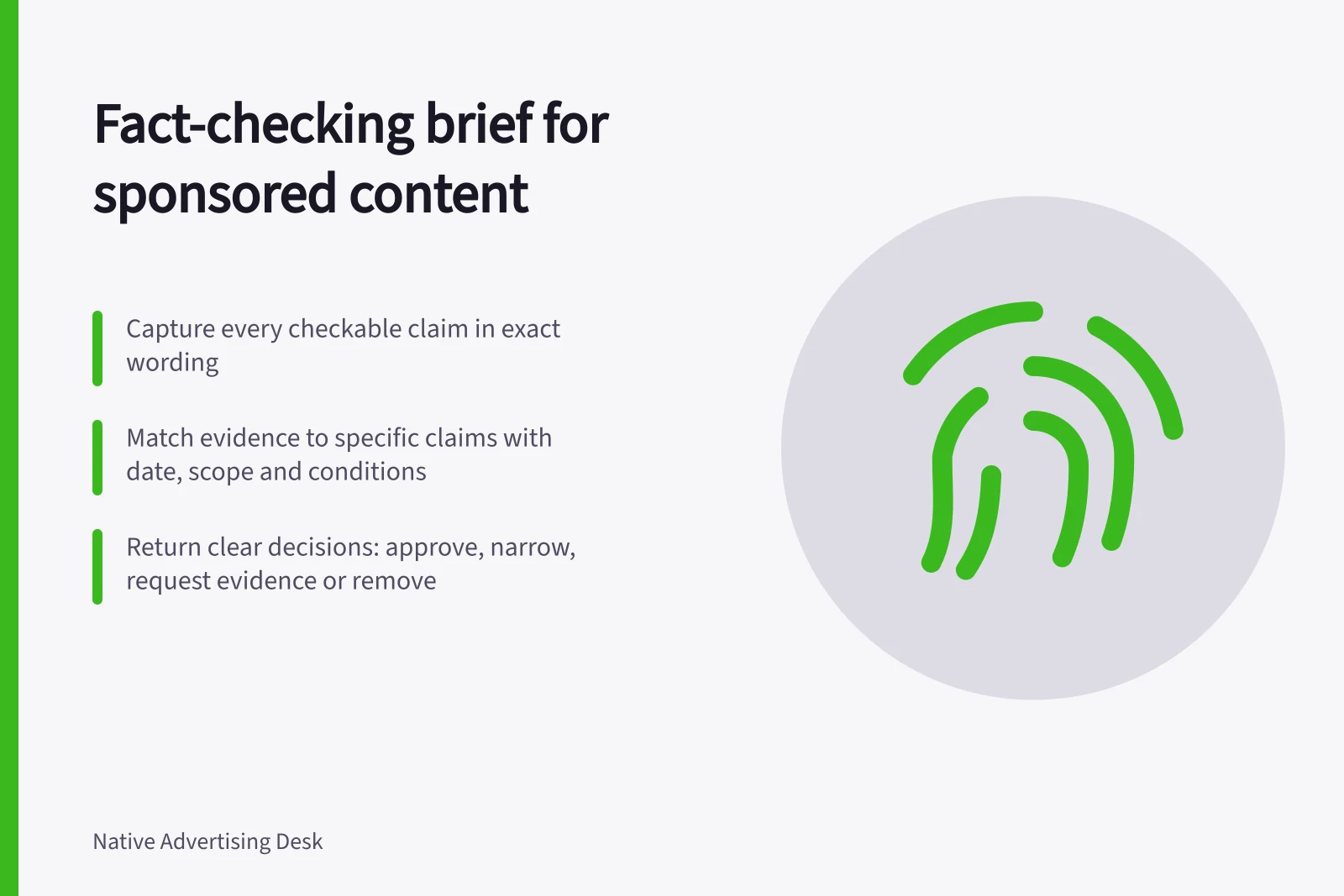
- Approve, narrow, request evidence or remove
Match evidence to wording
A current specification may support a feature description; it does not, by itself, show that the feature saves every customer time. A case study about one client needs wording that preserves that client's circumstances. For a comparison, record the alternatives, measure and period. For an outcome, ask how it was measured.
Check whether the offer is current and available to the audience named in the copy. Put a material plan, location or eligibility condition beside the claim it limits.
The Australian Competition and Consumer Commission (ACCC) says it can require businesses to back up claims they make about their products or services. Internal sign-off does not substitute for evidence that fits the published words.
Return a decision the writer can use
For each row, give approved wording where possible. If the evidence supports a narrower statement, write that statement. If support is inadequate, remove the claim and identify any headline, caption or section that depends on it. Keep unresolved rows visible rather than treating silence as approval.
When sponsor feedback or a product change alters an approved sentence, reopen its row and related promotional copy. The brief is ready for handover when each material claim in the proposed publication package can be traced to a decision and its stated limits.