Performance
Part of Measuring native advertising performance
Distinguishing cheap clicks from useful readership
Compare low-cost native clicks with recorded arrivals and qualifying article visits before judging whether a traffic source brings useful readers.
A low native ad click price is useful only if the traffic reaches and uses the promised content. Compare sources on recorded arrivals and qualifying article visits, then check the next action that matters to the campaign.
Follow the same path for each source
Use the same destination, article version, reporting period and article-specific qualifying-visit rule wherever possible. For each source, line up spend, reported clicks, recorded article arrivals and qualifying visits. If the campaign seeks enquiries, add eligible enquiries as a later outcome; a form submission alone may not meet that rule.
| Pattern | First question to investigate |
|---|---|
| Cheap clicks, few recorded arrivals | Did the destination load and analytics run? |
| Arrivals, little evidence of reading | Did the ad set the right expectation, and is the answer easy to find? |
| Qualifying visits, few relevant actions | Is the next step suitable and measured correctly? |
| Promising rates from very few visits | Is there enough evidence for a spend decision? |
A platform click and an analytics session are different units. Outbrain, for example, says repeat clicks can fall within one Google Analytics session and a visitor can leave before analytics runs. A gap is not, by itself, evidence of invalid traffic.
Compare the share that becomes useful
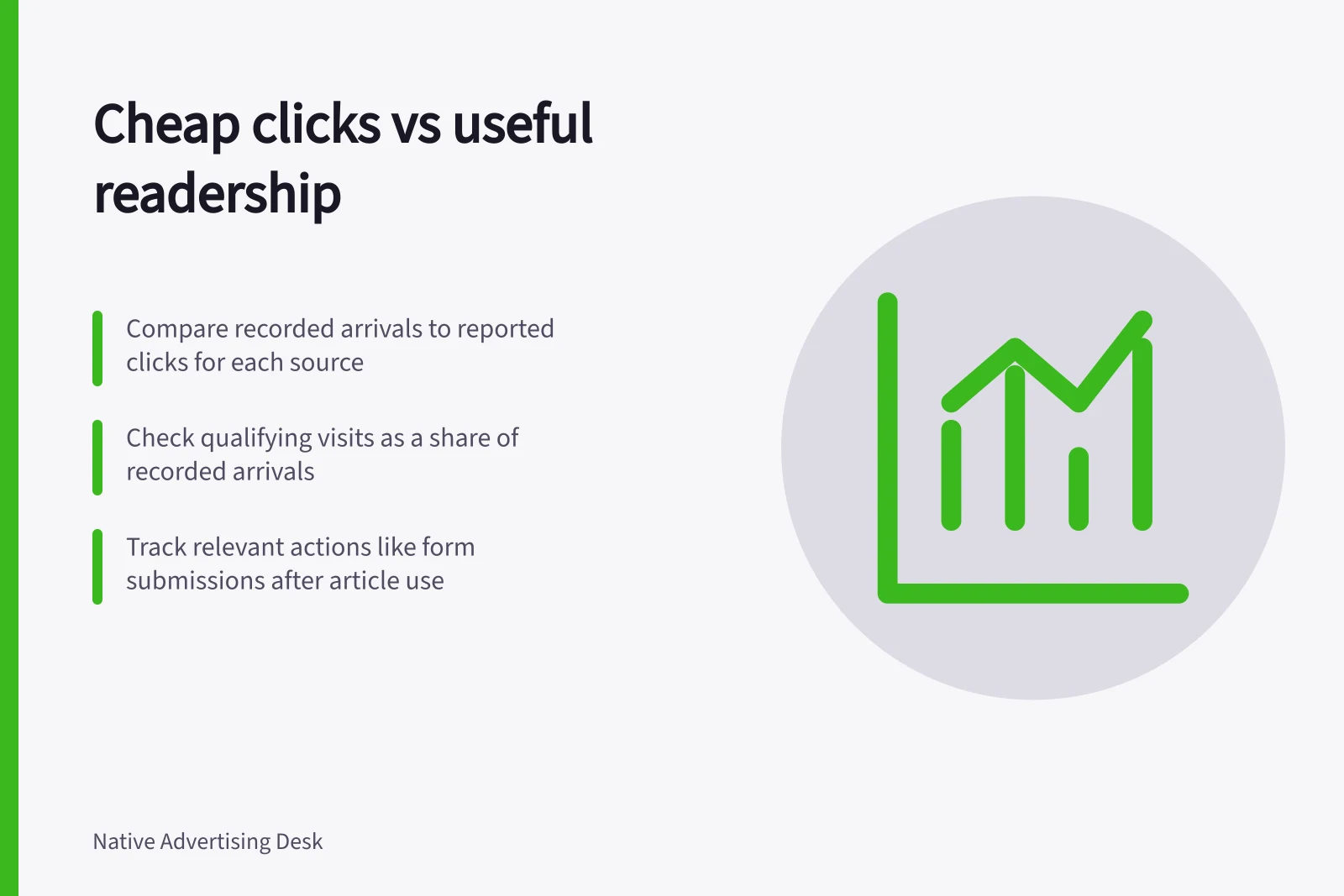
Start with two rates for each source: recorded arrivals divided by reported clicks, and qualifying visits divided by recorded arrivals. Label both as cross-system comparisons when the numerator and denominator come from different tools. They can locate a loss in the journey; they do not establish its cause. Check whether campaign tags, date boundaries and source names line up before comparing rates.
A cheaper source can lose its price advantage if few clicks turn into qualifying visits. Conversely, a higher click price may be reasonable when more visitors use the article and take a relevant action.
Keep spend and useful volume beside the rates so a small source with an attractive percentage does not dominate the decision. Detailed cost-per-engaged-reader accounting is a separate calculation.
Call the unit visits or sessions unless it genuinely counts distinct users.
Investigate differences before changing spend
A source may bring a different device or geographic mix, and creatives may make different promises. Record those differences before attributing a result to traffic quality. Small counts can also produce unstable rates; there is no universal click threshold for a reliable decision.
If one source repeatedly brings fewer qualifying visits under comparable conditions, a limited spend change can test whether useful volume improves. If weakness appears across sources, inspect the destination and tracking. Leave an inconclusive result labelled as such.