
Distribution
Native campaign targeting
Native distribution places a promoted item beside publisher content. Targeting should put the offer in a context and location where the next step makes sense …
Native distribution places a promoted item beside publisher content. Targeting should put the offer in a context and location where the next step makes sense, without narrowing delivery so far that a campaign cannot learn. Start with the reader's question and the offer, then choose the smallest set of controls needed to reach eligible people.
Key Native Advertising Insights from Australian Regulators and Experts
- ACCC on Ad-Tech Competition
- Lack of competition affects publishers, advertisers, and consumers
- BandT on Consumer Relevance
- Native content speaks in the consumer’s language – brands must align accordingly
- Outbrain Publisher Filtering
- Available for excluding specific publishers or sections
- Taboola Contextual Availability
- Varies by country and language – check account controls before launch
Build from the offer outward
State who can use the offer, where it is available and how much prior knowledge it assumes. A guide explaining a new category may suit a wider set of related editorial topics. A product demonstration intended for buyers ready to compare options needs a more focused destination. The headline and landing page must match that stage; targeting cannot rescue an offer that promises the wrong thing.
For guidance on choosing contextual categories and reviewing audience geography, see the dedicated guides. Outbrain offers targeting options and publisher filtering and exclusion. Taboola says its contextual availability varies by country and language; check current account controls before launch.
Connect targeting decisions to the campaign's broader purpose before launch. Ian McClelland of Guardian Australia has said native advertising works in the context of a broader strategy, and advertisers need to know why they use it and how it relates to their other activity. Write that purpose down; it helps the team decide whether a targeting control supports the campaign rather than making delivery narrower.
Understand the contextual signal
Contextual targeting can use the type of content a person is consuming at the time, rather than relying on a separate audience profile. Taboola describes its approach as relying solely on its contextual classification algorithm and says it is unaffected by privacy limitations or the advent of a cookieless world. Treat this as a description of Taboola's method, not a guarantee that every platform uses the same signal.
Before selecting a control, identify what it is classifying: the content being consumed, a declared audience attribute or another signal. That distinction helps you assess whether the control fits the campaign's purpose and what a change in delivery may mean. Keep the targeting method clear in campaign notes so results are not mistaken for evidence about a different audience signal.
Include publisher fit in the decision
Native content runs within a publisher's environment, so audience fit includes how the message works in that environment. Avid Collective's Luke Spano argues that brands should articulate the product with the audience in mind, share the message they need to communicate and allow publishers to tailor it to their readers. When planning targeting, consider whether the publisher's voice can make the offer relevant without changing what the offer promises.
Review the trade-offs
| Control | Useful question | Risk of overuse |
|---|---|---|
| Context | Is the surrounding topic relevant? | Excludes adjacent topics with useful readers |
| Geography | Can the visitor act on this offer? | Lowers scale beyond the real service area |
| Placement exclusion | Is a specific section unsuitable or persistently poor? | Removes worthwhile reach across other sections |
| Audience signal | Is there a legitimate, reliable basis to use it? | Narrows delivery and complicates interpretation |
For guidance on excluding irrelevant placements while preserving useful reach, see the dedicated guide.
In this guide
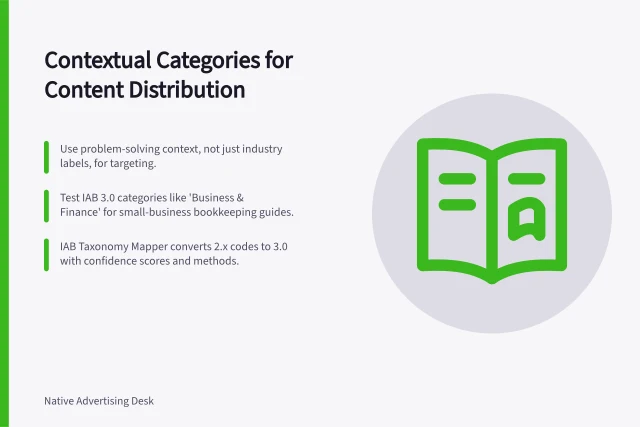
- Choosing contextual categories for native distributionChoose contextual categories from the problem the promoted content answers, not from the advertiser's industry label alone. A bookkeeping guide might be useful …
- Reviewing audience geography in a native campaignGeographic targeting begins with fulfilment. Where can a visitor buy, book or receive the service? Map that area first, including delivery boundaries and language …
- Matching native offers to the reader's stage of interestA reader who is learning a topic needs a different next step from one comparing vendors. Native targeting can put an offer beside related content, but the creative …