Compliance
Native advertising strategy for publishers and brands
Plan a native campaign around the reader’s question, clear sponsorship, agreed delivery and measures that publishers and brands can assess.
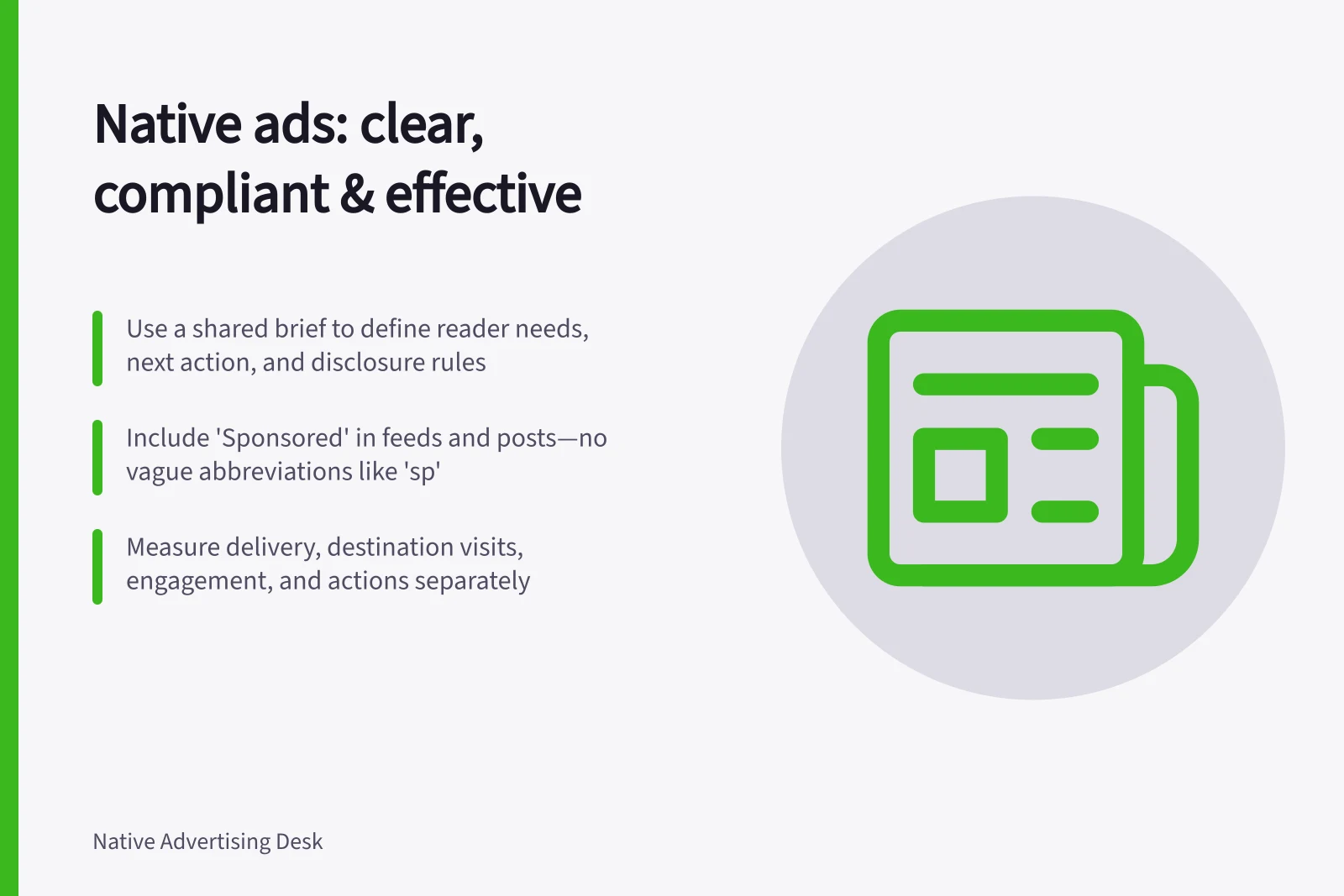
Start a native advertising strategy with three decisions: what the reader should learn, what the brand wants the reader to do next, and how the publisher will make the paid relationship clear. Agree on these before choosing a format or buying distribution. Put them in a shared brief and carry them through review.
For the brand, this creates a reason to pay for useful attention. For the publisher, it defines an offer that suits its audience and is recognisable as advertising. Clicks alone cannot tell either party whether the campaign worked.
Write a brief both sides can use
State the reader’s question in plain language. “Help first-home buyers compare contract features” is an illustrative starting point; “raise awareness” is too broad to guide the content.
Name a reasonable next action, such as reading an explanation or requesting a guide. Agree how the campaign will recognise that action before production begins.
Agree on five things before production. Keep the decisions in one shared campaign brief.
- Reader and context:Who is this for, and why would they encounter it here?
- Useful answer:What will the destination explain even if the reader never buys?
- Commercial role:Who pays, who controls the message, and how will readers recognise the arrangement?
- Delivery:What will be created, published, promoted and reported? Separate commitments from estimates.
- Decision measure:What result would justify continuing, changing or ending the campaign?
The publisher should be able to decline a topic that does not suit its audience. The brand should be able to assess the promised placement and reporting before agreeing to buy.
For product or service claims, name the brand-side contact for content queries and agree who will review claims before publication. Record who gives final approval when the evidence and copy are ready.
Choose a format and distribution route
A sponsored feature can work through a substantial question; an in-feed item can introduce an answer and lead to a suitable destination, while video may help explain a process that benefits from demonstration. Match the format to the brief and reader’s needs, then confirm creative requirements with the supplier. Outbrain lists Standard, Carousel (up to 10 images), App Install, Outstream Video, Clip and Vertical Video formats; Outstream Video is available only via its internal DSP, Zemanta.
Decide separately where the item will appear. A direct publisher agreement can commit to named deliverables when they are written into the agreement. A distribution network may place creative across several environments, but surfaces and reporting depend on the provider and campaign settings.
Outbrain says its formats dynamically fit placements across publisher partners in open web and in-app environments. Specify the approved environments and placements in the campaign agreement rather than treating network availability as guaranteed.
Ask for sample placements and report fields, including delivery and results by placement where available. A publisher name in a report does not, by itself, identify an exact page position; ask for placement evidence if that distinction matters.
Native Ad Formats and Best Use Cases
- Sponsored FeatureBest for in-depth explanations of complex topics; suitable for long-form content.
- In-Feed ItemIdeal for introducing a solution or answer within a content stream; drives clicks to destination.
- Outstream VideoEffective for demonstrating processes; available only via Zemanta DSP.
- Carousel (up to 10 images)Good for showcasing multiple features or steps; supports visual storytelling.
- Vertical VideoOptimised for mobile; ideal for short, engaging narratives.
Make the commercial relationship clear
Native advertising can resemble surrounding content, so review the commercial cues in the feed, on the destination and on a phone. A cue that appears only after a click cannot help someone interpret the item before clicking.
Check the headline, image and destination together. Record the support for each claim and put any qualification that changes the main impression alongside the main message, where readers will notice it.
For Australian campaigns, apply the Australian Consumer Law: businesses must not mislead or deceive consumers, including through hidden advertising. Agree the disclosure wording before production; use “Sponsored” in the feed, not vague abbreviations such as “sp” or “spon”.
Review claims and agree how concerns will be handled
Before publication, have the brand identify the evidence supporting each product or service claim and have the publisher check that the material it receives is adequate for review. The ACCC can require businesses to back up claims, and may investigate misleading claims and take compliance or enforcement action.
The Australian Consumer Law requires businesses not to mislead or deceive consumers. Agree who will receive and assess a concern about the campaign, and who can pause or correct material if needed.
The ACCC accepts reports about possible misleading or false claims and uses them to inform its education, compliance and enforcement work. It does not resolve individual disputes or provide legal advice.
Check disclosure in social placements
If the campaign includes influencer posts, check that the commercial relationship is clearly disclosed in the post itself and that the disclosure is easy to notice. In its review of 118 social media influencers, the ACCC found that 81 per cent had posts raising concerns about potentially misleading advertising; common issues included missing disclosures and vague terms such as “sp” or “spon”.
Preview each post in the formats and placements where it will appear, including on a phone, and check that the disclosure remains visible. Use the agreed “Sponsored” wording in the post itself, where readers can see it before engaging.
ACCC Findings on Influencer Disclosure Compliance
- Percentage of influencer posts with disclosure issues
- 81%
- Common disclosure problems
- Missing disclosures, vague terms like 'sp' or 'spon'
- Recommended disclosure wording
- 'Sponsored' – visible before engagement
Measure the path and make a decision
Follow the sequence placement delivered → destination reached → useful engagement → intended action. Each step answers a different question. An impression does not prove attention, and a click does not prove the page loaded or was read.
Do not treat a platform engagement measure as proof of a specific content action. Define a separate measure if the campaign needs that evidence, such as a count of a specified engagement event or intended action.
Before launch, record the reporting period, campaign tags, cost basis and desired action. Set one observable field for each step—delivered impressions, destination visits, a defined engagement event and an action count—and agree which party supplies it. During delivery, check technical faults before changing creative or excluding a placement. Afterwards, compare actual delivery with the agreement and note what the evidence cannot show.
In this guide
- Native advertising versus earned editorial coverageSee how paid native content and earned editorial coverage differ in control, timing, reader disclosure and what a brand can expect.
- Choosing a native format for a reader's information needMatch native ad formats to what readers need to learn, from an in-feed prompt to an article, card sequence or video.
- Matching native distribution to a campaign objectiveChoose native distribution by the result needed, the placement control required and the evidence available to assess delivery.