Distribution
Part of Native campaign targeting
Matching native offers to the reader's stage of interest
A reader who is learning a topic needs a different next step from one comparing vendors. Native targeting can put an offer beside related content, but the creative …
A reader learning a topic needs a different next step from one comparing vendors. Native targeting can place an offer beside related content, but the creative and destination must explain why that offer belongs in the moment.
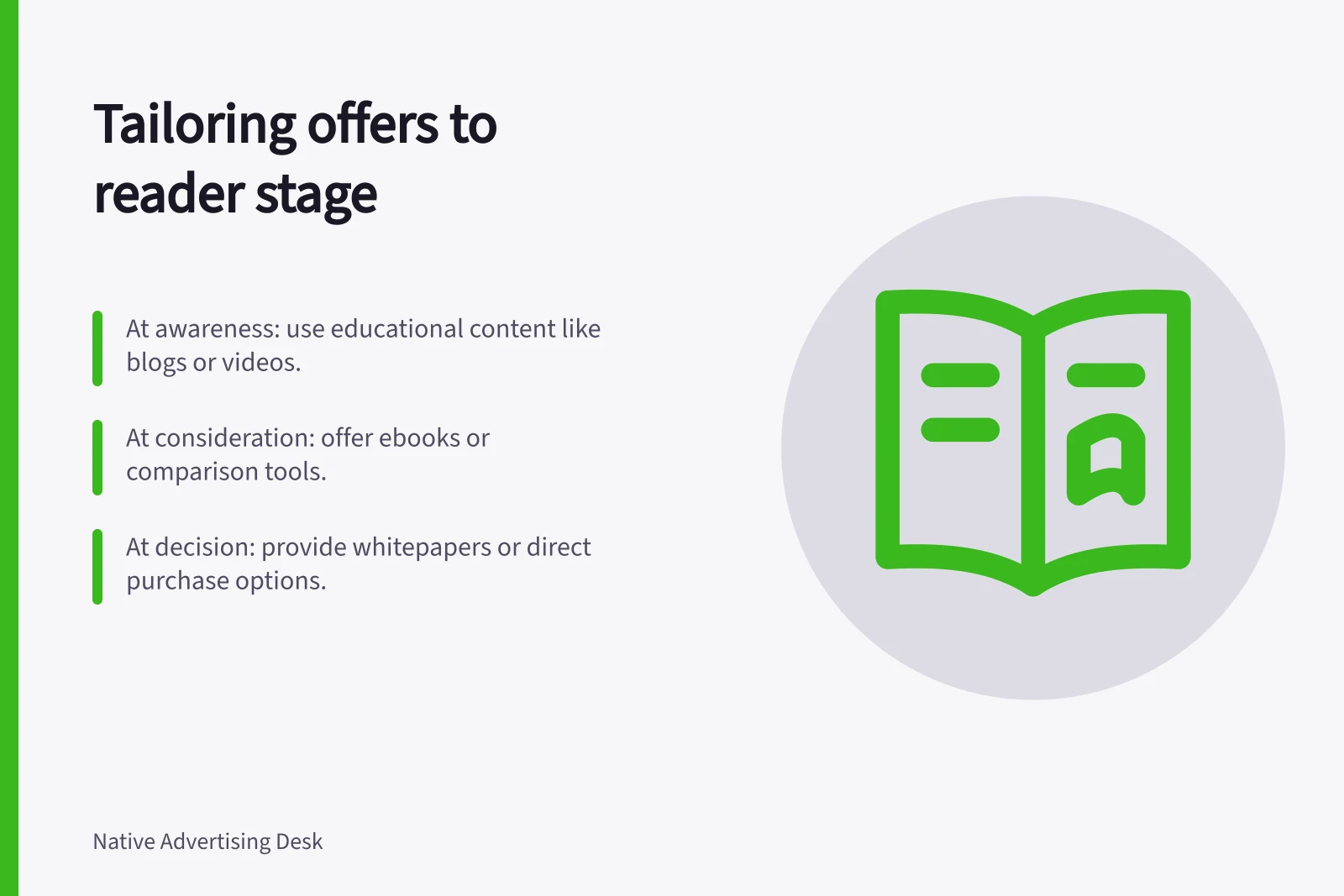
Use three working stages: awareness (learning what a topic is), consideration (evaluating options) and decision (choosing an option). These names organise an offer hypothesis; they do not prove an individual reader's intent.
At awareness, match an educational article or blog, original research or video. These formats build demand at the top of the funnel, and the destination should help the reader understand the topic or when it is useful.
At consideration, match an ebook, interactive tool, whitepaper or comparison page. These formats help buyers evaluate options; the page should answer which option fits the reader's constraints.
At decision, match a case study or demo, which can provide proof and product context. A consultation asks for more commitment, so give a clear reason to act now.
Diagnose a stage from the publisher page's subject and task, not from a presumed individual profile. Educational content suggests awareness, comparison content suggests consideration, and case-study or demo content suggests decision; treat each as a hypothesis, not a certainty.
Write a stage hypothesis this way: Because the publisher page is educational, comparison-focused or proof-oriented, hypothesise awareness, consideration or decision; match it to an offer format; then state what the destination provides and what next action would be useful.
For example, an educational article can lead to original research, a comparison page to an interactive tool or whitepaper, and case-study content to a demo. A consultation can suit a decision-stage reader when its reason to act is clear.
Check the path from publisher page to native headline to landing page. The headline should describe what the destination actually provides, and the first screen should deliver it; for example, a headline offering original research should lead directly to that asset.
Do not label every visitor to an introductory article a purchase-ready prospect. Contextual targeting can help organise an offer test, but content context does not establish an individual's intent.
Choose a success measure that fits the commitment: a useful read for an awareness offer, a requested guide for consideration, or a qualified enquiry for decision. Click-through rate alone cannot tell whether the offer matched interest.
Test two adjacent offers with the same eligible geography and comparable placements. If one draws more clicks but fewer suitable next actions, inspect the promise and page before narrowing the audience; Taboola describes Contextual Targeting as using the type of content a user is consuming in real time.
Matching Native Offers to Reader Stages of Interest
- AwarenessEducational content (e.g., blog, article, video) to build understanding of a topic. Destination: original research or explainer content.
- ConsiderationComparative or evaluative content (e.g., comparison page, interactive tool, whitepaper). Destination: asset that helps assess options based on constraints.
- DecisionProof-focused content (e.g., case study, demo, consultation). Destination: offer with clear urgency and context to act now.