Distribution
Part of Native advertising economics
Budgeting for content production and distribution separately
Set separate production and distribution lines, assess bundled quotes, and reforecast when a content change affects the media budget.
Separate production and distribution into their own budget lines before committing to a native campaign. Production funds the asset; distribution funds its promotion and placement. Showing both costs helps you judge whether a proposed content change justifies the audience spend it may displace.
Estimate production by deliverable
List every deliverable the brief requires: the article or other asset, images and design, variants, fact-checking, sponsor review, accessibility work and amendments. Include internal time alongside supplier invoices. State review rounds and who pays if the brief changes.
Record ownership and reuse rights next to the cost. If one asset serves several campaigns, choose an allocation method for reporting. Keep the actual invoice visible: allocating its cost does not make it free.
Plan distribution by route
For each publisher placement or other traffic source, record the spend limit, dates, destination, audience or placement conditions, and promised delivery. A booked newsletter inclusion differs from an estimated number of visits. Publisher pages may show formats available for discussion, but they do not reveal the exposure, rights or price included in your quote.
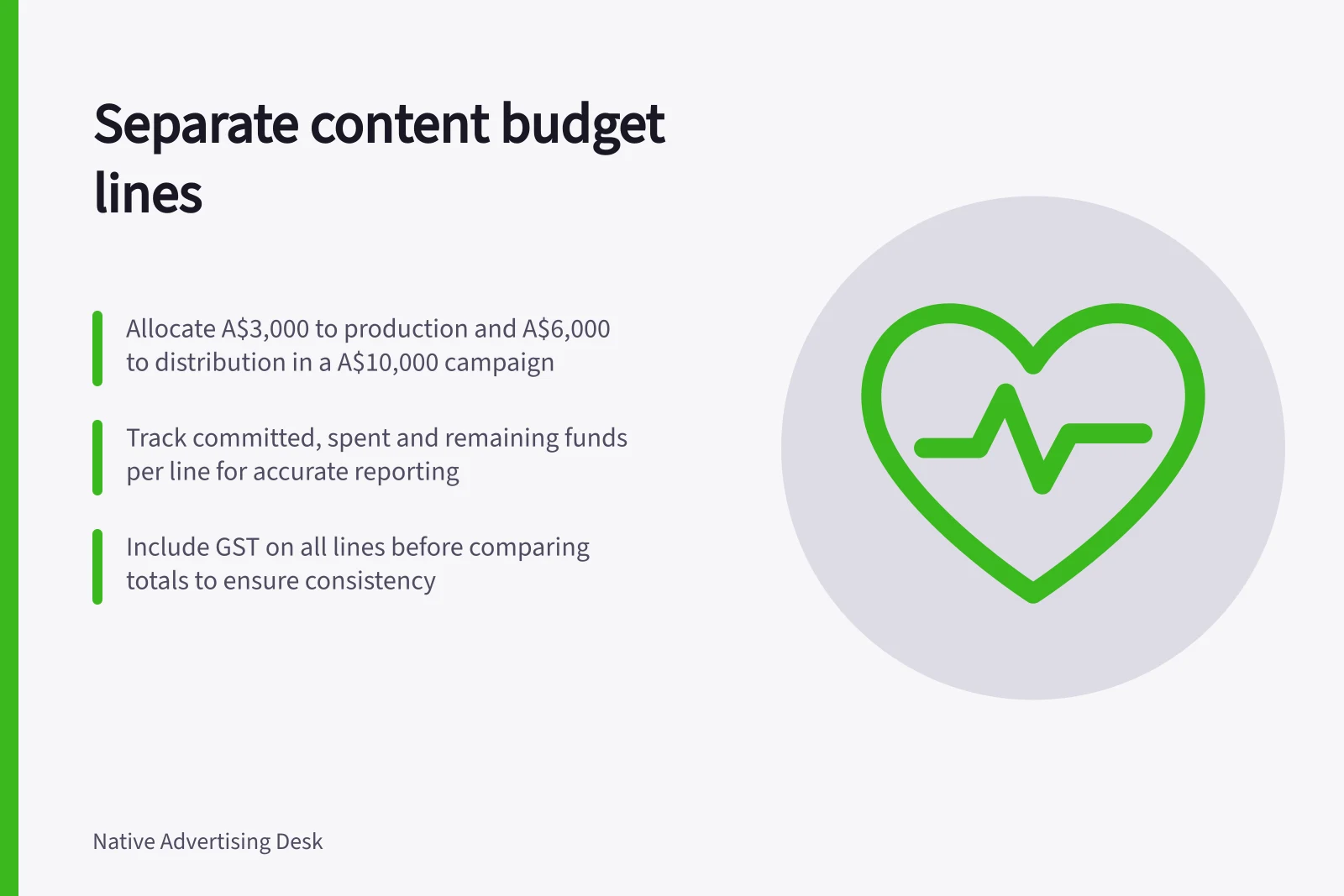
Give measurement and likely revisions their own allowance where needed. Use the same GST basis across all lines before comparing totals.
| Budget line | Record | Decision supported |
|---|---|---|
| Production | Cost by asset and revision allowance | Can the agreed asset be delivered? |
| Distribution | Cap by placement or channel | What exposure can be bought and tested? |
| Measurement | Setup and reporting cost | Can the outcome be counted? |
| Contingency | Allowance and approval owner | How will an agreed change be funded? |
A bundled supplier quote can still be assessed this way. Ask which creation, publication, promotion and reporting deliverables it includes. If the supplier cannot separate prices, obtain separate deliverables and acceptance criteria.
Production vs Distribution Budget Lines: Key Differences
- Purpose
- Funds creation of the content asset (e.g. article, design, fact-checking)
- Purpose
- Funds promotion, placement, and audience reach (e.g. newsletter feature, publisher page inclusion)
- Key Considerations
- Ownership and reuse rights, revision rounds, internal time, supplier invoices
- Key Considerations
- Spend limits, dates, audience conditions, promised delivery, exposure clarity
- GST Treatment
- Must apply same GST basis across all budget lines for accurate comparison
Steps to Separate and Manage Content Budgets
- Identify all deliverablesList every production component (article, images, variants, accessibility work) and distribution route (publisher placements, traffic sources)
- Assign costs and ownershipRecord cost per asset, include internal time, clarify who pays for revisions if brief changes
- Define distribution parametersFor each route, record spend limit, dates, destination, audience conditions, and delivery promise
- Allocate measurement and contingencyInclude setup/reporting costs and an approved contingency allowance
- Refactor when changes occurAdjust budget lines if a change impacts another line; track committed, spent, and remaining amounts
Reforecast when a line changes
Suppose an illustrative A$10,000 budget assigns A$3,000 to production, A$6,000 to distribution and A$1,000 to measurement and changes. An extra A$1,500 design feature would require a higher total ceiling or an explicit reduction elsewhere.
If the extra A$1,500 comes entirely from distribution, that line falls to A$4,500. Decide whether the feature serves the objective better than the planned exposure it replaces; the figures do not predict performance.
During the campaign, track committed, spent and remaining amounts for each line. Afterwards, report both media-only and all-in cost per outcome so the next budget can distinguish content decisions from distribution decisions.