Distribution
Part of Native video and interactive formats
Comparing in-feed video with sponsored article distribution
Compare in-feed video and sponsored article distribution by reader path, booked deliverables and the measures that answer your campaign question.
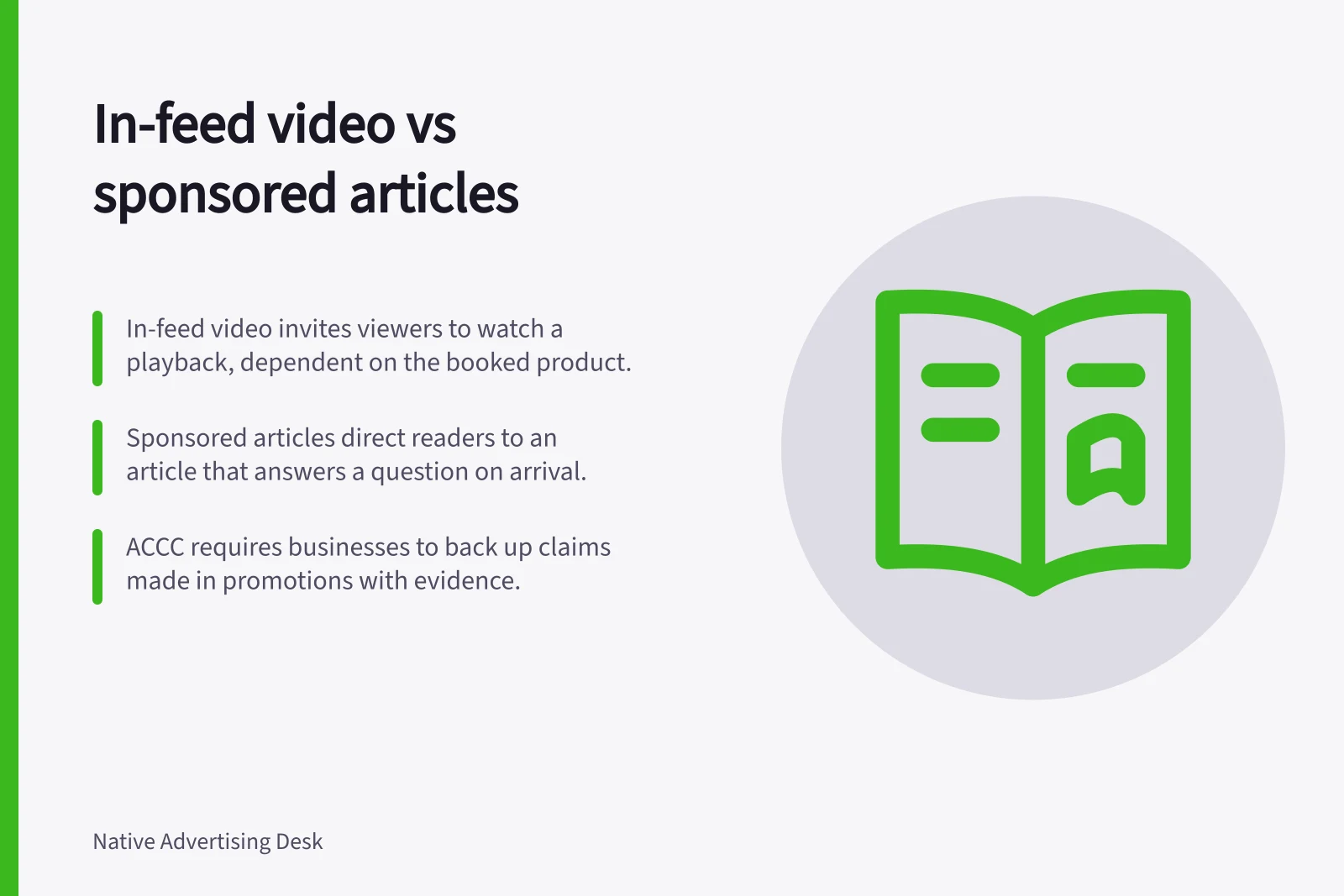
Compare these routes by the action the promotion invites. An in-feed video unit leads people towards watching a video, although playback and click behaviour depend on the booked product. Sponsored article distribution leads people towards reading an article at a destination.
Choose the route whose entry point and main asset can deliver the campaign's answer. Neither a reported view nor a click proves understanding.
Compare the reader paths
| Decision | In-feed video route | Sponsored article route |
|---|---|---|
| Entry promise | What will watching show? | What will reading explain? |
| Main asset | A video reached or presented under the booked format | An article that answers the promoted question on arrival |
| Better reason to consider it | The answer depends on seeing an action or change | The answer needs detail, qualifications or comparison at the reader’s pace |
| Reporting question | What counts as a view, progress and a useful next action? | What counts as a click, recorded arrival and useful article visit? |
Playback, click and reporting rules vary by booked product. Confirm the proposed unit before making creative for it.
Match the asset to the answer
A hypothetical equipment guide might use video to show assembly and an article to hold specifications, conditions and steps readers may want to revisit. If both assets are needed, give each a clear job and make the promotion say which one the reader will reach. A video promise that leads to an unrelated form, or an article promise that leads only to a teaser, needs revision.
Check the headline, image, frames, narration, captions and destination together. The ACCC says it can require businesses to back up claims they make about their products or services. A qualification in the article cannot reliably correct a broader impression made by the promotion.
Compare proposals on the same basis
Ask each supplier for the booked surface, playback and sound behaviour, destination, mobile treatment, sponsorship cue, dates, creative specifications and report definitions. For an article, establish who creates it, where it lives, how long it remains available and which promotion is committed. Separate booked deliverables from forecasts.
Keep production and distribution costs visible, and compare quotes on the same GST basis. This is a route decision, not a full campaign budget exercise: the question is whether the proposed spend covers the asset and delivery needed to give readers the promised answer.
Use the report to judge the chosen route
For video, request the supplier's view rule and a progress measure covering the explanatory section. Definitions can vary between suppliers, so confirm what each reported measure counts.
For an article, compare reported clicks with recorded arrivals and an article-specific action under stated definitions. A click and an analytics visit are different units.
If the objective is learning, assess understanding separately. Watching, clicking and scrolling can help diagnose the path, but they cannot establish what readers learned.