Distribution
Part of Native campaign targeting
Choosing contextual categories for native distribution
Choose contextual categories from the problem the promoted content answers, not from the advertiser's industry label alone. A bookkeeping guide might be useful …
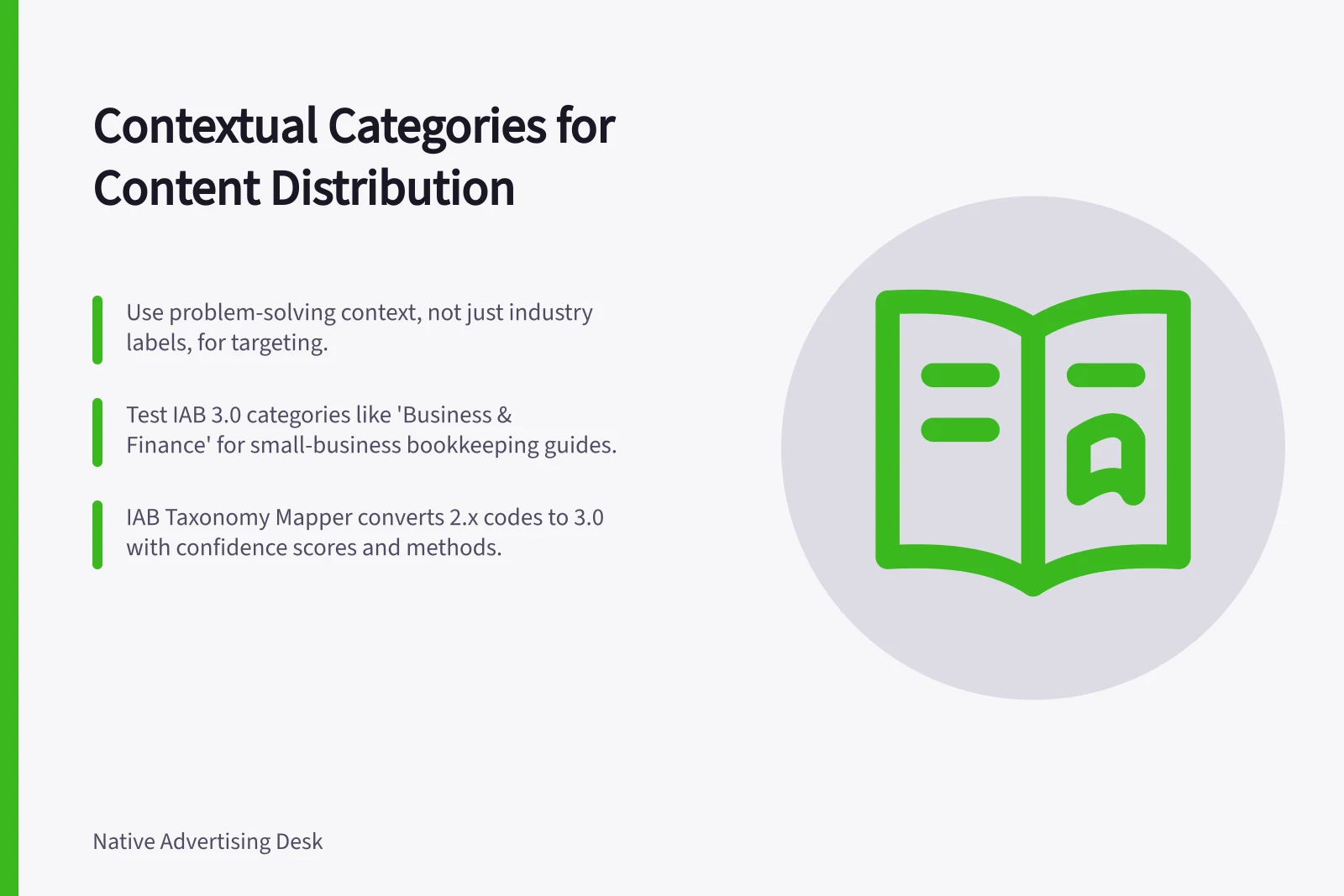
Choose contextual categories from the problem the promoted content answers, not from the advertiser’s industry label alone. A bookkeeping guide may suit small-business planning content even when the page is not classified as “accounting”. Start with several plausible editorial contexts, each with a clear reason.
The IAB Content Taxonomy provides a common language for describing content used in contextual targeting. Outbrain’s IAB category examples range from the broad “Business & Finance” to the more granular “Hobbies & Interests > Chess”.
For a bookkeeping guide answering “How should a small business organise its books?”, test Business & Finance even if the page is not labelled accounting. For a question about learning chess, Hobbies & Interests > Chess is a more specific candidate than a broad category.
The IAB Tech Lab Taxonomy Mapper converts 2.x category codes into 3.0 equivalents. Upload CSV or JSON in its interface, or run the CLI locally, then review the mapped codes, labels, confidence scores and methods. Content Taxonomy 3.0 expands coverage from ~400 categories to 1,500+, and 2.x is being deprecated.
In Outbrain’s Amplify dashboard, open the campaign setup’s Targeting section, choose Contextual IAB Category Targeting, then select categories from the dropdown. Outbrain categorises publisher content at page and article level, rather than only at domain level.
Taboola Contextual Targeting selects based on the type of content people are consuming, in real time, using Taboola’s contextual classification algorithm. Availability and diversity depend on the targeted country and language, so check these for the campaign before choosing categories.
After delivery begins, review actual publisher pages and sections against the intended reader question. A relevant page topic does not mean every visitor is ready to buy; Outbrain provides IAB Category reporting through Scheduled Reports and its API.
Use a test matrix with the category, intended reader question, matching creative, destination and success signal. Set a useful delivery level and evaluation window before comparing categories.
For an introductory guide, judge engaged visits and a meaningful next step. For a specific offer, include eligible enquiries or purchases where measurement permits.
Compare an adjacent category against the same creative, destination and success signals before deciding that one label is inherently better.
Keep exclusions separate from category selection: reserve them for genuinely unsuitable categories or consistent failure against the defined objective at useful volume, and revisit the rationale when the creative or offer changes.
IAB Content Taxonomy 2.x vs 3.0: Key Differences
- Status
- Being deprecated
- Status
- Active and recommended
How to Choose Contextual Categories for Native Distribution
- Identify the reader’s problem or questione.g., 'How should a small business organise its books?'
- Select relevant IAB categories based on context, not industrye.g., Business & Finance instead of Accounting for bookkeeping content
- Set up targeting in Outbrain Amplify or TaboolaChoose Contextual IAB Category Targeting in campaign setup
- Test and evaluate performanceCompare engagement, next steps, and conversions using a test matrix
Top IAB Contextual Categories for Small Business Content
- Business & FinanceHigh relevance for financial planning guides
- Hobbies & Interests > ChessSpecific match for learning-focused content
- Education > Career DevelopmentSuitable for skill-building content
- Personal FinanceIdeal for budgeting and savings guides