Compliance
Part of Native advertising for product education
Explaining a complex product without disguising the sponsor
Explain a complex product through its inputs, process, output and conditions while making the sponsor’s role clear.
Explain a complex product by showing what goes in, what it does, what comes out and which conditions change the result. Identify the sponsor before the explanation begins and keep its perspective clear. Technical detail can make a paid article useful while the commercial relationship remains visible.
Follow the product’s actual workflow
Start with a task the reader recognises. For a hypothetical scheduling platform, that might mean describing information a manager enters, the schedule produced and the decisions a person still needs to make. The example is a writing model, not a description of a real platform.
Part of the explanation / Question to answer
- Input
- What must the user provide or connect?
- Process
- What does the product do with it?
- Output
- What can the user see, export or act on?
- Condition
- What setup, plan, location or user action is required?
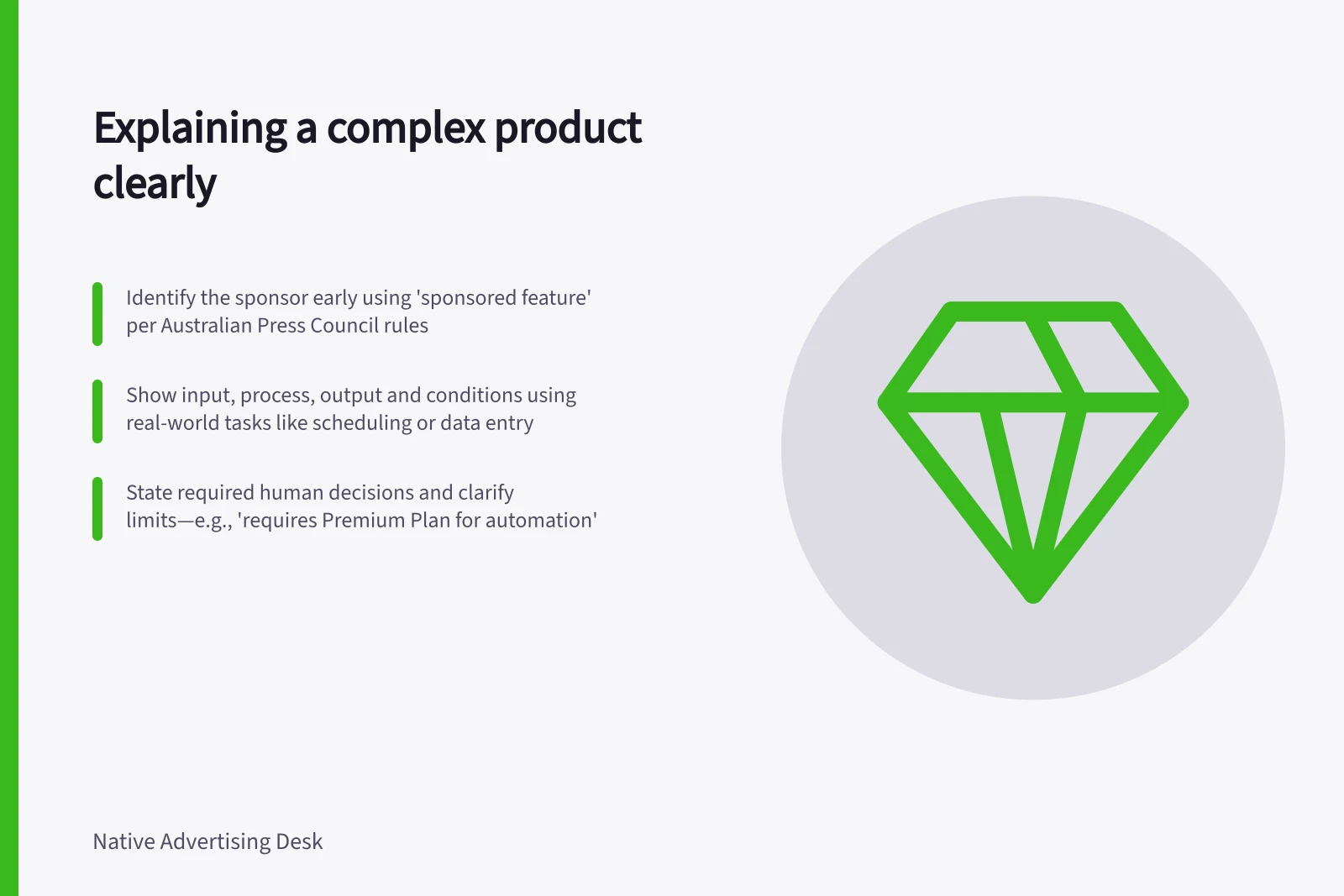
Define a technical term when it first matters. Keep the term if buyers will meet it in the product or agreement, and explain what it means for their task. State any required human decision rather than implying that the product completes it.
How a complex product works: Input, Process, Output, Condition
- InputWhat must the user provide or connect?
- ProcessWhat does the product do with it?
- OutputWhat can the user see, export or act on?
- ConditionWhat setup, plan, location or user action is required?
Name the sponsor’s perspective
A clear opening identifies the article as sponsored and names the company whose product it explains. Check both the promotional entry point and the article page. The Australian Press Council says advertorials should be identified with terms such as ‘sponsored feature’ so readers do not mistake them for editorial content free of commercial influences.
Avoid implying an independent review when the article presents the sponsor’s account. Attribution can identify a viewpoint, but it cannot verify a claim about performance or availability. The ACCC can require businesses to back up claims about their products or services and can investigate if a business misleads.
Key compliance requirements for sponsored content in Australia
- Sponsor identification
- Use terms like 'sponsored feature' or 'paid content'
- ACCC enforcement power
- Can investigate misleading claims and require evidence
- Editorial independence
- Cannot imply independent review when content is commercial
Explain conditions beside the functions they affect
If a capability depends on a particular plan, integration, location or setup, say so with that capability. Explain what happens when a required input is missing. When evidence supports a function but not a customer outcome, describe the function without promising the outcome.
A comparison needs named alternatives and checkable criteria. If evidence is available only for the sponsor’s product, explain that product on its own terms and give readers questions they can ask about other options.
After reading, someone unfamiliar with the product should be able to describe its purpose, inputs, output, important limits and sponsor relationship. If they can repeat only a slogan, the explanation needs more work.
Evaluating sponsored claims against ACCC guidelines
- Sponsor’s claimProduct delivers X outcome under all conditions
- ACCC requirementClaims must be substantiated and not misleading; outcomes depend on user input, plan or integration
- Best practiceExplain function with conditions; avoid implying full automation without human input