Distribution
Part of Native advertising strategy for publishers and brands
Matching native distribution to a campaign objective
Choose native distribution by the result needed, the placement control required and the evidence available to assess delivery.
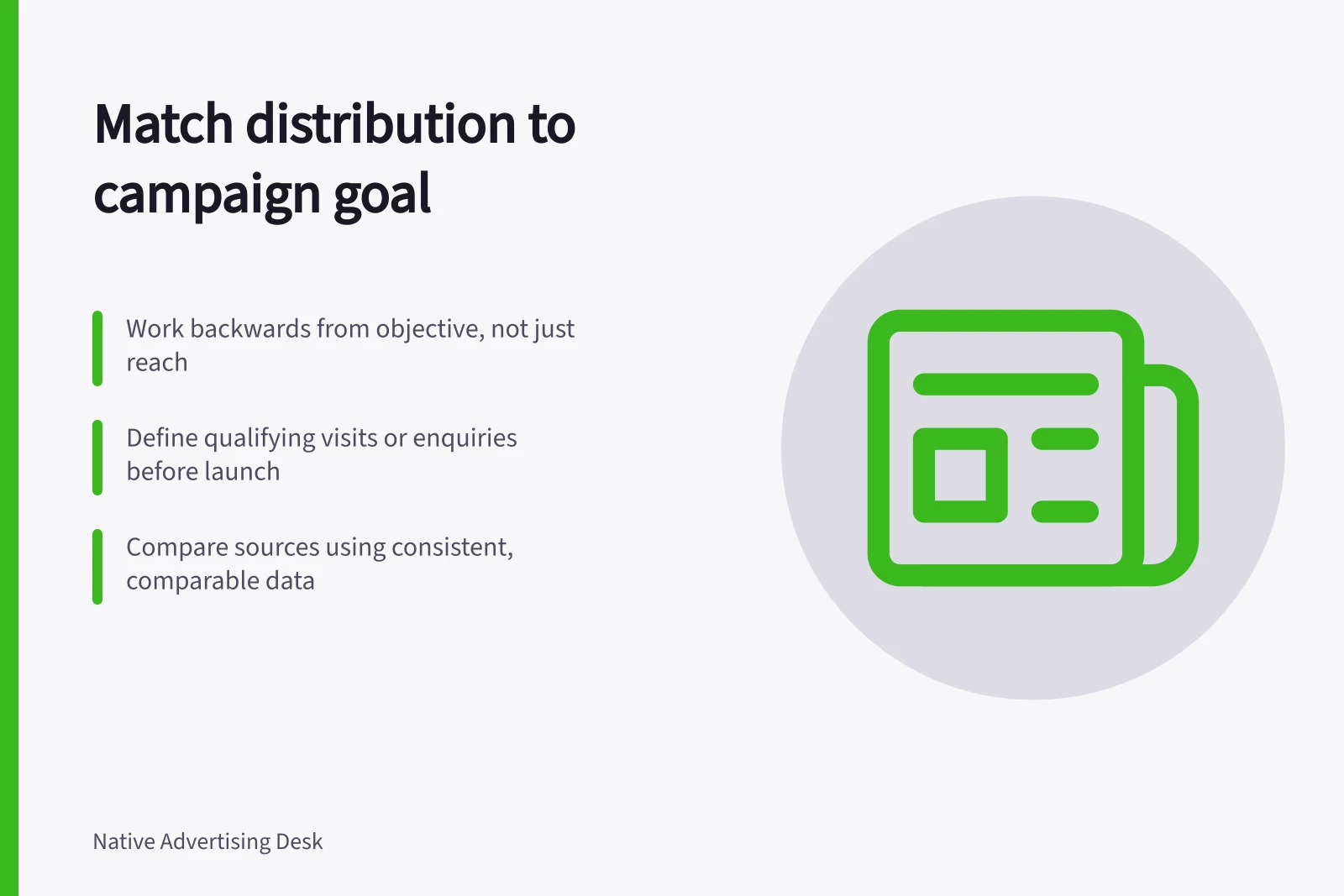
Choose native distribution by working backwards from the campaign objective; reach alone does not settle the decision.
Turn the objective into a delivery requirement
| Objective | What distribution must provide | First result to inspect |
|---|---|---|
| Introduce a topic | Relevant contexts and enough delivery to reach the intended audience | Where the promotion appeared and whether people reached the destination |
| Encourage a useful read | A clear route to the full explanation | Content visits under a defined rule |
| Generate eligible enquiries | Geography and placement conditions suited to the offer, plus action tracking | Eligible enquiries, using landing visits to diagnose gaps |
| Support a booked publication moment | Agreed dates and named promotional surfaces | Delivery against the written schedule |
Treat these as planning measures, not guaranteed results. Define a qualifying visit or enquiry before launch. That way, a supplier’s click count is not mistaken for the outcome.
Key Performance Metrics by Objective
- Introduce a topic
- Where promotion appeared; whether people reached destination
- Encourage a useful read
- Content visits under defined rule
- Generate eligible enquiries
- Eligible enquiries via landing visits; diagnose gaps
- Support a booked publication moment
- Delivery against written schedule
Compare routes by the control required
Consider a direct publisher arrangement when a particular publication context, surface or launch date matters. Ask for a written schedule covering what will be published and promoted, when, for how long and with what report. A sales menu does not establish that a placement is included in a quote.
Consider a distribution network when the campaign needs several sources and the team can review delivery. Ask what placement and reporting controls the network can provide, and whether its reported surfaces match the reader experience the campaign requires.
Neither route guarantees a suitable context or service area. Set the controls that matter most. Confirm Australian availability and account settings with the supplier.
Set up the measurement path
Record the destination, campaign identifiers, dates, spend basis and intended action. For a reading objective, use a consistent content-visit rule. A session-level engagement signal alone does not establish a completed read.
For an enquiry objective, check whether the action is recorded and whether the resulting enquiry meets the agreed eligibility rule. A distribution platform may report clicks and tracked conversions; destination analytics and customer records answer different questions.
Reconcile dates and units before calculating rates. If reported clicks rise without corresponding landing visits, inspect loading, redirects and tracking before judging the source.
Review the mix
Compare sources only where the report provides a useful breakdown and the periods and destinations are comparable. A source with cheap clicks but few useful visits may deserve less spend. A source with fewer clicks may still serve the objective if its readers take the intended action. Check the amount of data and possible technical causes before changing the mix.
End with a decision to continue, change the mix, repair the destination or stop. Record the evidence and its limits so the next campaign can use what this one actually showed.