Sponsored Editorial
Part of Sponsored article production
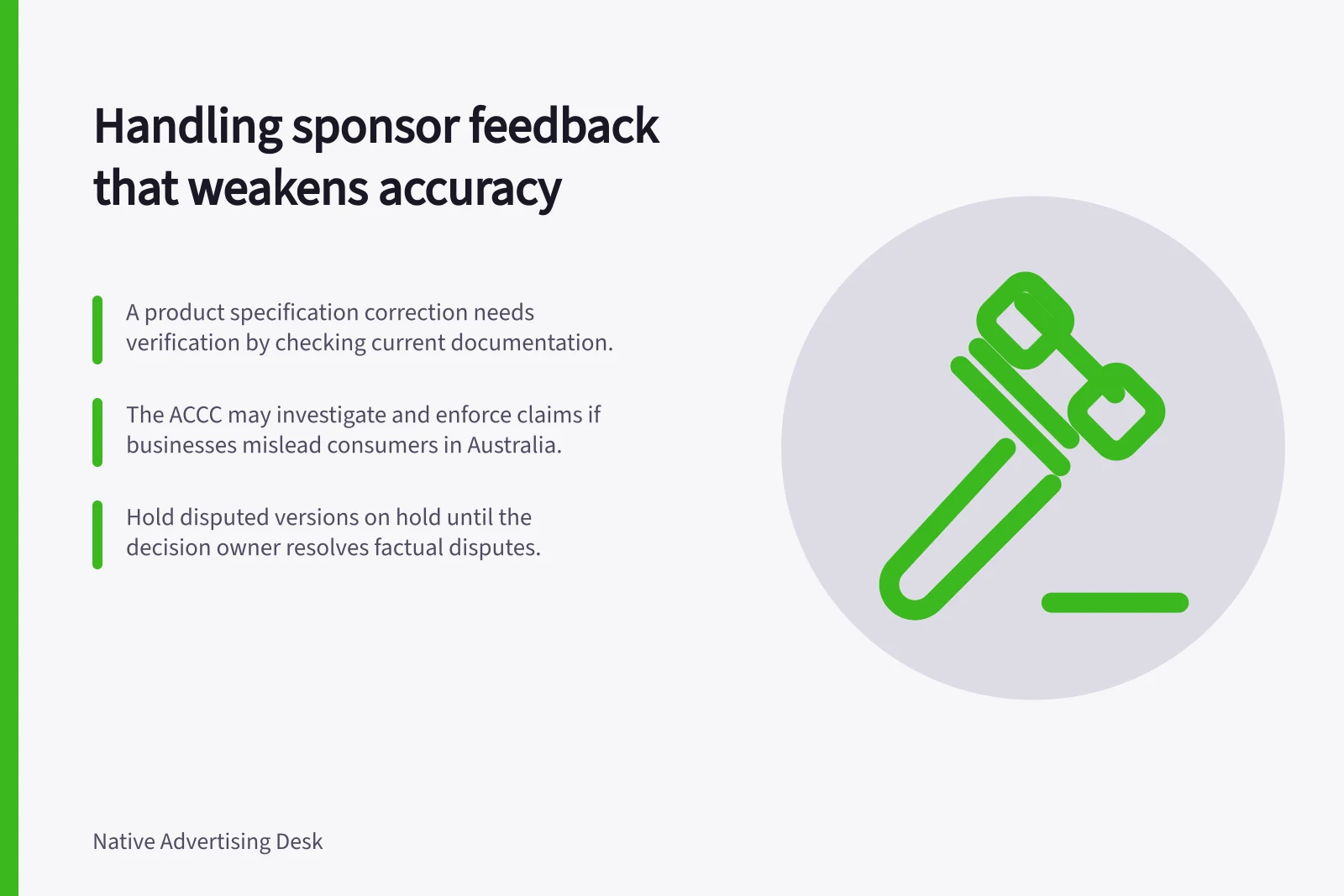
Handling sponsor feedback that weakens accuracy
Respond to sponsor edits that overstate claims or remove material limits with evidence-based wording and a clear escalation route.
If a sponsor asks for a change that would weaken accuracy, isolate the passage and the impression it would create. Ask for evidence, offer wording the evidence supports, and hold the affected version until the decision owner resolves the dispute. A messaging preference does not settle a factual claim.
Identify what the change does
A product specification correction needs verification. A tone edit may leave meaning intact. Removing a condition, strengthening a comparison or turning a qualified result into a general promise changes the claim itself.
Ask for one consolidated response: the passage, the proposed replacement and the reason. Compare that with the claim record, including its date and scope. Read both the literal wording and what a reader would infer if a condition is omitted.
Impact of Sponsor Edits on Claim Accuracy
- Correcting outdated feature
- Requires verification against current documentation
- Removing a material exception
- May mislead; must retain condition or narrow claim
- Changing 'some' to 'all' customers
- Requires evidence for broader group; otherwise keep qualified wording
- Replacing reader answer with sales claim
- Must preserve factual response; show where product message fits without displacement
Offer a workable revision
| Request | Response |
|---|---|
| Correct an outdated feature or offer | Check current documentation, then update affected passages and the teaser. |
| Remove a material exception | Keep the exception beside the claim, narrow the claim or remove it. |
| Change “some customers” to “all customers” | Request evidence for the broader group; otherwise retain the narrower wording. |
| Replace the reader’s answer with a sales claim | Show where the product message can fit without displacing the agreed answer. |
The Australian Competition and Consumer Commission (ACCC) can require businesses to back up claims about their products or services. It may investigate and take compliance or enforcement action if a business misleads. This information can help frame a wording decision; it does not establish that a particular edit has been cleared.
A reply can state the evidence boundary plainly: “The material covers this plan in Australia from the stated date. We can use that wording with the eligibility condition beside it. The proposed broader line goes beyond the material.”
If the sponsor supplies better evidence, assess it and revise. Otherwise, offer a narrower statement or change the angle.
Regulatory & Evidence-Based Guidelines
- ACCC Authority
- Can require businesses to substantiate claims; may enforce action for misleading content
- Evidence Boundary
- Wording must match available material; broader claims need stronger proof
- Trust in Messaging
- Clear, evidence-based language helps gain reader trust and compliance
Escalate the disputed version
Send an unresolved claim to the decision owner agreed before production. Include the current and requested wording, the evidence, the material condition and the effect on the headline or article. Mark the affected version as on hold. A change to the central claim may require a new headline or opening, not just a local sentence edit.
After resolution, update the claim record and circulate the changed passage to everyone whose approval it affects. Confirm the exact version approved. If neither party accepts an accurate version, delay or withdraw the affected content under the agreed process.