Performance
Part of Optimising a native advertising campaign
Improving the destination before buying more native traffic
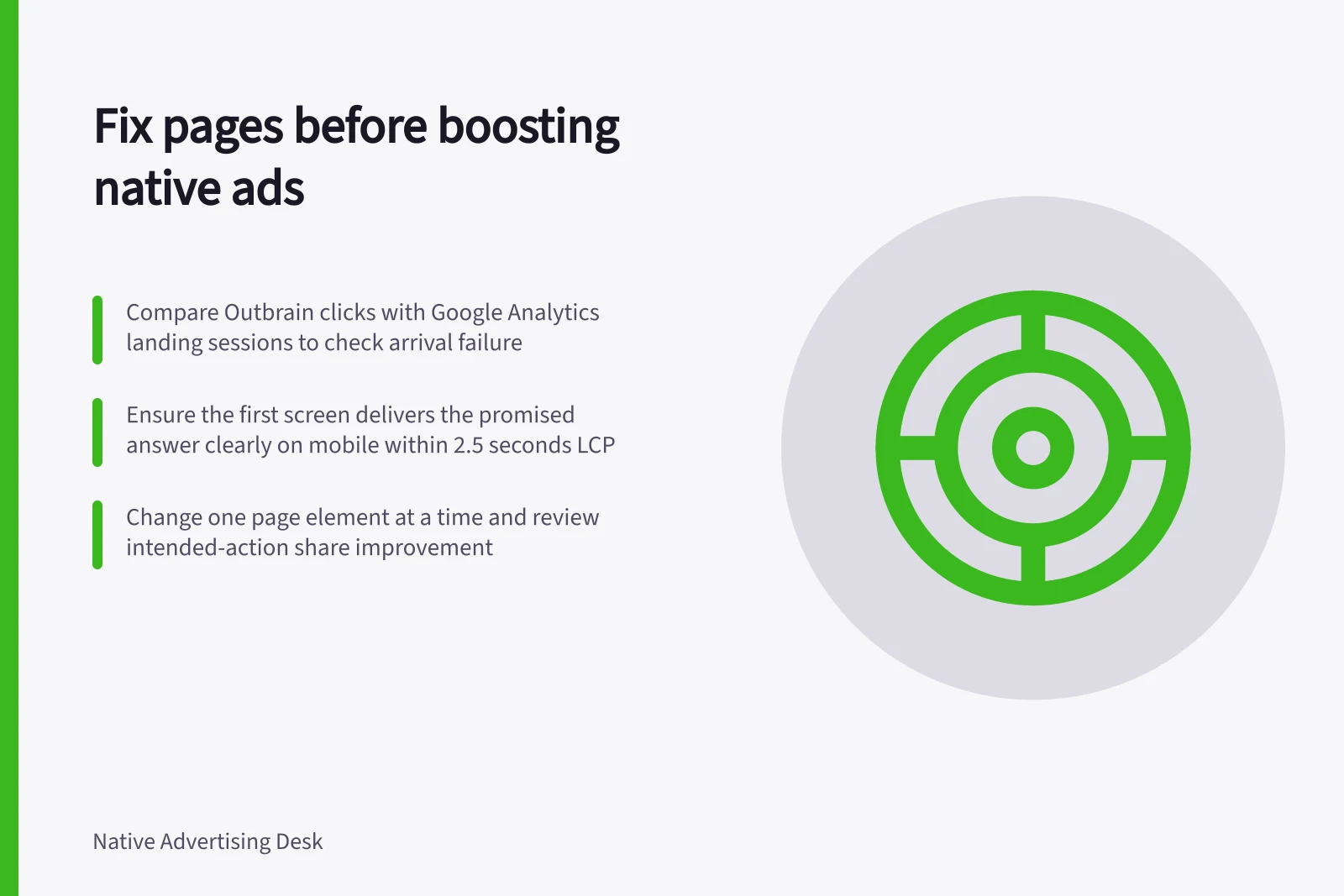
Check arrival tracking, the first mobile screen and the promised answer before increasing native ad traffic.
First decide whether native clicks are failing to arrive in recorded landing sessions or whether recorded visitors reach a page they cannot use. Compare Outbrain clicks with Google Analytics landing sessions, then inspect the page against the ad promise and intended action. Make one page change and review it before increasing native spend.
Separate arrival failure from page failure
For the same campaign and dates, compare Outbrain reporting clicks, Google Analytics recorded landing sessions and intended page actions. Outbrain and Google Analytics can report different figures because these are different units; a gap calls for an arrival check, not an automatic judgement about the audience or page.
Open the campaign URL on a phone. Check redirects, campaign parameters, loading and whether Google Analytics records a landing session; compare that with Outbrain reporting for the same campaign and dates. Google Analytics URL builders create custom URLs for collecting campaign data.
Check the first useful screen
Read the ad headline, then view the destination as a new visitor. Does the title confirm the promised subject, and can the reader find the answer without navigating around a form, overlay or unrelated sales introduction? Is a condition that changes the main claim visible with that claim?
The ACCC says it can require businesses to back up claims about their products or services, and may investigate misleading conduct or take compliance or enforcement action.
Largest Contentful Paint (LCP) reports when the largest visible content element renders, so it is a loading signal, not a measure of whether the answer is clear. For a good user experience, aim for LCP of 2.5 seconds or less at the 75th percentile, segmented across mobile and desktop; inspect the mobile page itself as well as any speed report.
Performance Benchmarks for First Useful Screen on Mobile
- Target LCP (75th percentile, mobile)
- ≤ 2.5 seconds
- ACCC Guidance on Misleading Claims
- Requires substantiation of product/service claims
- Ideal User Experience (UX) Standard
- Clear answer visible without navigation or overlays
Change the page against a diagnosis
Before editing, define the intended page action and use the share of recorded landing sessions that include that action as the page measure. Keep the arrival check separate: compare Outbrain clicks with recorded Google Analytics landing sessions.
| Problem to verify | Change to consider | Result to review |
|---|---|---|
| The promised answer appears late | Move the answer and key conditions towards the opening. | Does the intended-action share improve? |
| The first screen is difficult on a phone | Fix loading or obstructive elements. | Does mobile LCP meet 2.5 seconds or less at the 75th percentile, and does the intended-action share improve? |
| Visitors find the answer but stop | Make the next step clearer and appropriate to the answer. | Does the intended-action share improve? |
Change one page element at a time. Keep the creative and buying mix as stable as practical, and record both page versions and the release date.
Set a review point before release and compare like-for-like campaign periods after both page versions have recorded arrivals. Increase native spend only if the intended-action share improves, the URL loads and arrivals are recorded. If the result is inconclusive, hold spend and continue the comparison; if the share does not improve, revert the page change.