Performance
Part of Native placement quality
Identifying placements with unusually weak engagement
Compare like-for-like native placement engagement, check tracking and device effects, and investigate weak sources before changing delivery.
Flag a native placement when its visitors engage materially less than visitors from comparable placements using the same creative and destination. Investigate the difference before changing delivery; weak engagement alone does not identify its cause.
Choose a comparable outcome
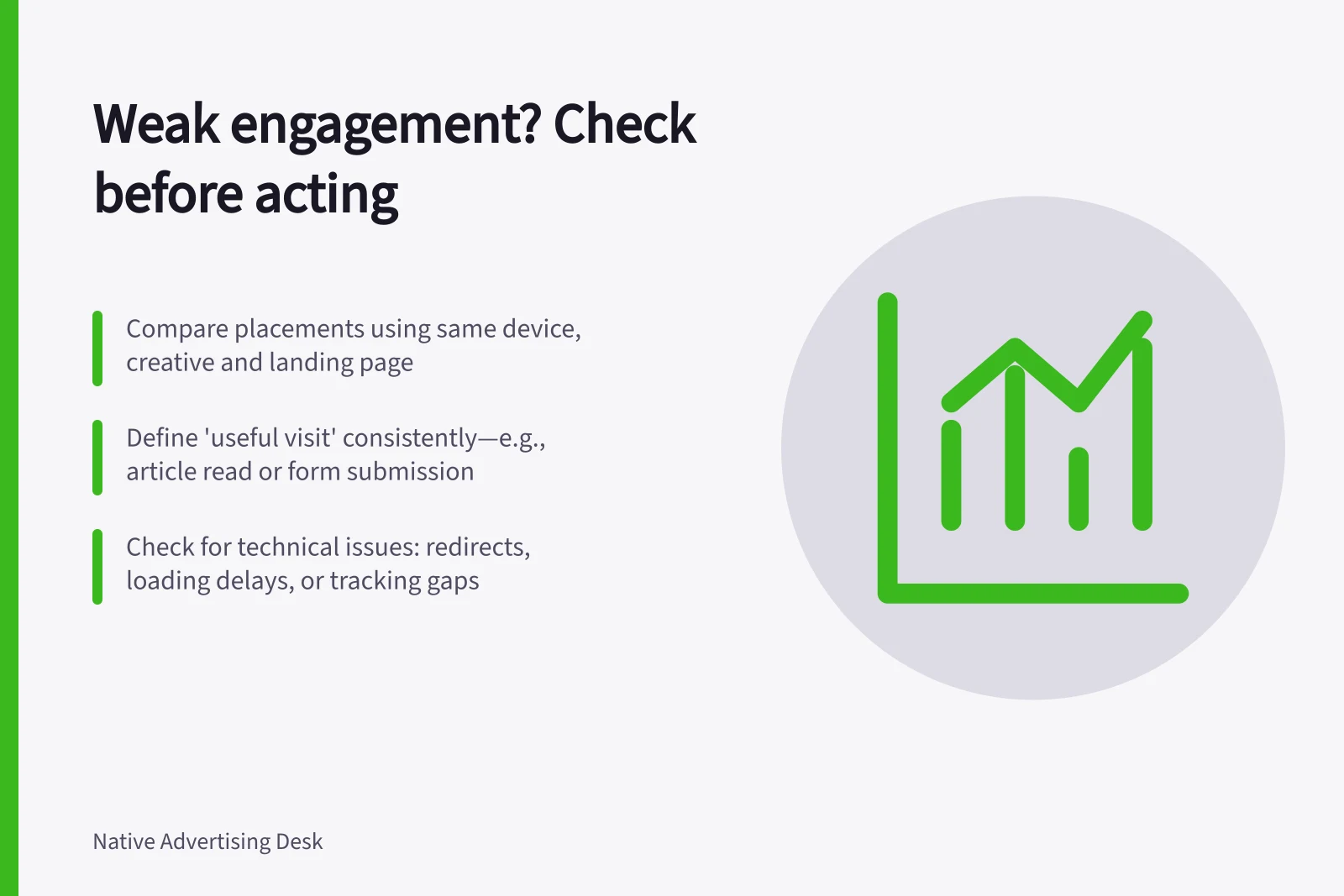
Define a useful visit before sorting the report. For a sponsored article, that may mean a loaded page and a relevant content action; for an enquiry page, a qualified next step may matter more. Use the same outcome definition and reporting period for every placement compared.
Do not treat a platform-level engagement metric as proof that a reader understood the content. Define an article-read outcome separately and use it consistently across placements.
Compare placements within a sensible peer group. Keep device, geography, creative, landing page and campaign period as similar as the available data allows. If one section ran mainly on mobile and another on desktop, a raw difference may reflect the device experience.
Review both the number of visits and the rate: a small number of visits can produce an unstable percentage. There is no useful universal minimum for every campaign decision.
Check likely causes
| Pattern | First check |
|---|---|
| Many reported clicks, few landing sessions | Redirects, tags, page loading and differences between click and session counting |
| Landing sessions arrive but show little activity | Loading, first-screen relevance and the creative's promise |
| Weak results mainly on one device | Mobile rendering and the placement context |
| One creative performs poorly within the same section | Whether it creates the wrong expectation |
| Weak results across sources | Destination and measurement setup before placement quality |
An Outbrain click and an analytics session are different units. Repeat clicks can fall within one session, and a visitor may leave before the analytics tag loads. A gap between these totals does not establish invalid traffic.
Record the weak placement, its comparison group, visit counts, outcome rates and checks performed. If the pattern persists after those checks, request more placement detail or make a controlled delivery change. Judge the change by useful visits, not merely by the disappearance of a weak row.