Performance
Part of Native placement quality
Investigating repeated clicks from low-quality sources
Investigate repeated native ad clicks with source-level records, technical checks and a specific platform review request.
Repeated clicks from one native source warrant investigation when they are concentrated, unusual against comparable delivery, and followed by little useful landing activity. They do not prove invalid traffic on their own. Establish what was counted, preserve records, and ask the buying platform to review a specific source and period.
Confirm the pattern
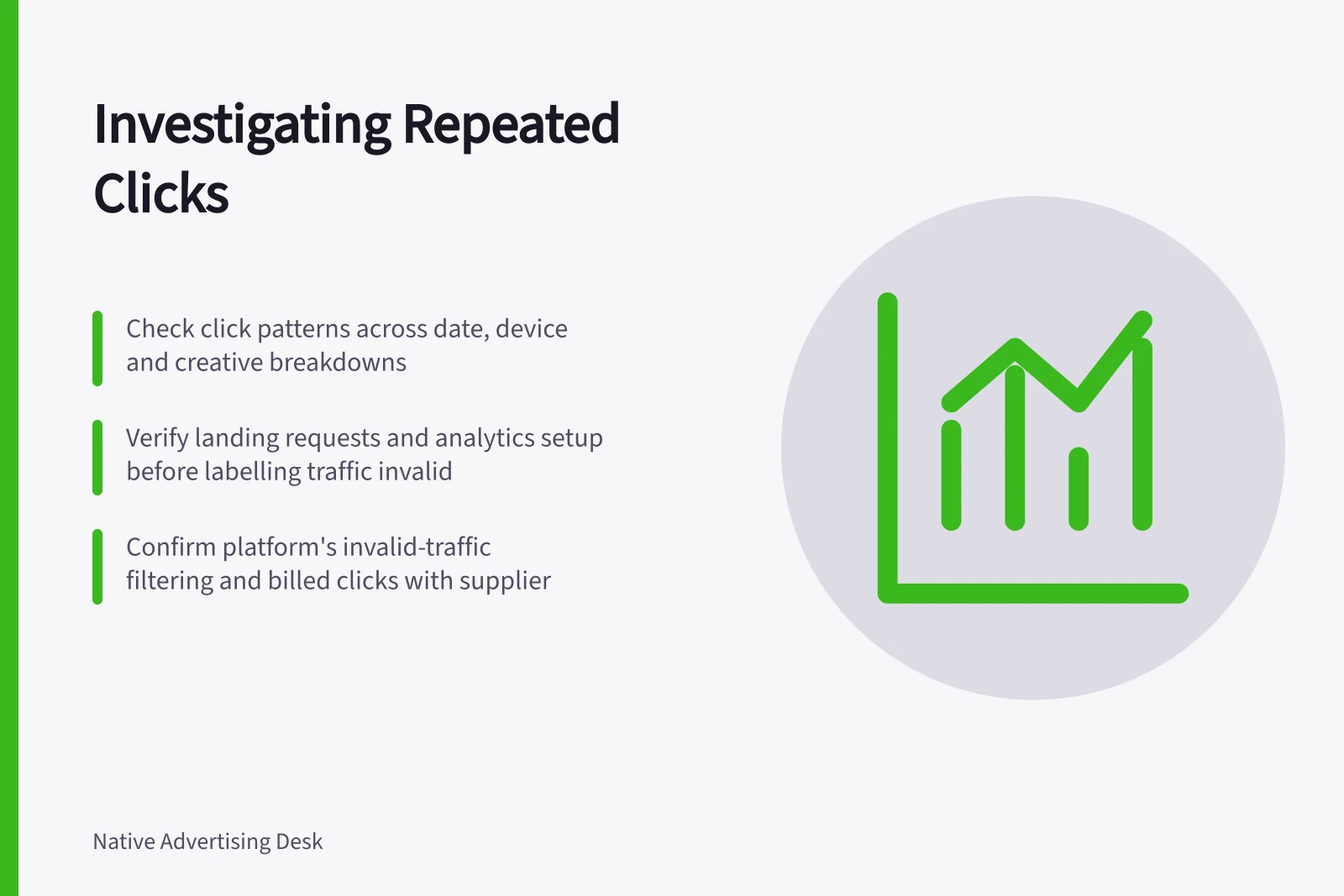
Break down the campaign by publisher or section, date, device and creative where reporting permits. Look for sudden changes in click frequency, clusters of clicks close together, or a large gap between clicks and landing visits. Compare the source with its earlier delivery and with similar sources using the same creative and destination. A spike may reflect a new placement, a reporting change or a genuine increase in exposure.
Do not equate every click-to-session gap with invalid traffic. Outbrain explains that repeat clicks can fall within one analytics session and that a visitor can leave before analytics code runs. Check tags, redirects, date boundaries and page availability before raising a traffic-quality allegation.
Assemble the evidence
Keep the original platform report. Note the campaign ID, source or section identifier, creative, affected dates, device split, clicks, spend and landing sessions.
If available under your data-handling rules, retain relevant server timestamps, landing requests and platform click identifiers. Send records through the supplier's appropriate review channel.
Question / Evidence to check
- Was activity concentrated?
- Source, section, device and time breakdowns
- Did visitors reach the page?
- Landing requests, analytics setup and redirect checks
- Was traffic useful?
- The campaign's defined qualified-visit or action measure
- Was activity already filtered?
- The platform's invalid-traffic and billing explanation, if available
The Media Rating Council distinguishes general invalid-traffic filtering from more sophisticated detection. An advertiser's aggregate chart or simple IP count cannot apply those methods or classify individual clicks. Ask the platform what it investigated and which figures, if any, it adjusted.
Valid vs. invalid traffic: What to check
- Activity concentration
- Check source, section, device and time breakdowns for anomalies.
- Page reach
- Verify landing requests, analytics setup and redirect functionality.
- Usefulness of traffic
- Assess against campaign-defined qualified visits or actions (e.g., form submissions).
- Filtering already applied
- Review platform's invalid-traffic filtering and billing adjustments.
Make a measured decision
If the source is consuming material budget while the issue is reviewed, consider a reversible pause if the campaign controls allow one. Record what happens to useful visit volume.
Ask which clicks were billed, which were filtered and whether the supplier's finding changes the delivery record. Do not claim a refund or accuse a publisher before the evidence supports it.
Close the case with the original observation, technical checks, supplier response, any adjustment and remaining uncertainty. Poor-quality attention can justify a performance decision even when invalid traffic has not been established.