Performance
Native advertising economics
Build a full native campaign cost ledger, connect useful visits to customer value, and compare options on the same economic basis.
A native campaign makes economic sense when its outcomes cover the full cost of creating, distributing and measuring it within a stated period. Start with the outcome you need, then work backwards through costs and likely conversion rates. A low cost per click alone cannot answer the question.
Ask early whether the campaign offers a value play for its intended audience, not just whether it can buy exposure. B&T reports Spano’s view that consumers may opt in to native content rather than experience it as a disruptive ad.
Count the full campaign cost
Cost / What to include
- Production
- Research, writing, design, revisions and assets
- Distribution
- Publisher placement, paid promotion and buying fees
- Measurement
- Tracking setup, reporting and analysis
If an asset will be reused, decide how much of its production cost to allocate to this campaign and record the allocation. Do not treat production as free because another team paid the invoice. Compare amounts using the same currency, GST basis and campaign period.
A publisher may bundle creation and exposure in one quote. Ask what will be made, published, promoted and reported, even if separate prices are unavailable. A public format menu does not establish what a particular quote includes.
Production effort may be a material constraint as well as a line item. Spano describes native content as resource-intensive, especially at scale, because it can require more complex creative; weigh that effort when judging whether the campaign is feasible to repeat.
The Australian publisher market is fragmented, with thousands of publishers, Spano says. A campaign across several publishers is therefore harder to organise; do not assume a plan that works with one publisher transfers unchanged across the market.
Full Cost Components in Native Advertising
- Production
- Research, writing, design, revisions, assets
- Distribution
- Publisher placement, paid promotion, buying fees
- Measurement
- Tracking setup, reporting, analysis (e.g., Google Analytics)
Connect attention to value
A useful sequence is spend → visits → engaged visits → qualified actions → customers. For a content education campaign, cost per engaged visit may be an early operating measure. A customer acquisition campaign also needs a cost per acquired customer and a credible estimate of customer contribution.
Label the denominator. An engaged session can come from a repeat visitor and does not prove that someone read an article.
Fit the format to the audience
Native advertising is paid advertising designed to match the look, feel and function of the media format where it appears. It can run on websites, in social media feeds or as promoted search results, so the campaign’s setting is part of the offer being assessed.
The Australian B&T interview with Avid Collective managing director Luke Spano recommends letting publishers communicate in their own language. That draws on publisher expertise, but the brand still needs to provide a clear message it wants conveyed.
Test the decision against break-even
To test the decision, total production, distribution and measurement costs to get the all-in campaign cost. Estimate engaged sessions and acquired customers under your chosen measurement rule, then derive the cost per engaged session and the cost per customer. Use the same currency, GST basis and campaign period throughout.
Compare the contribution from acquired customers over the chosen period with the all-in cost. If total contribution is below the all-in cost, the campaign has not recovered its cost within that period. The break-even number of customers is the all-in cost divided by the contribution per customer.
Work the calculation with your own illustrative figures; the result is an arithmetic test, not a price, result or forecast.
Compare options on the same basis
Publisher packages, traffic buys and reusable assets have different cost structures. Compare their full costs against the same outcome and period. Record guaranteed deliverables separately from estimated reach or results.
After launch, inspect the quality of visits and actions as well as their cost. If customer numbers are too small to judge, describe early measures as provisional rather than claiming a return.
Pre-Launch Checklist for Native Advertising Campaigns
- Confirm scope and deliverables with publisherEnsure clarity on what’s included in the quote
- Use consistent currency and GST basisAll costs in AUD, GST-inclusive, same campaign period
- Track quality of visits and actionsNot just volume—assess engagement and conversion quality
- Document provisional results if sample size is smallAvoid overstating returns when data is limited
Account for format and market complexity
For proposals involving several publishers or bespoke formats, specify who approves the scope, how changes affect cost, and what evidence is needed before committing further spend. That makes responsibilities and decision points clear before treating the campaign as readily repeatable.
Guardian Labs Australia lists premium articles, photo-led quizzes, photo galleries, flat lay articles, comic strips, flip cards, infographics, bespoke longform articles, podcast reads and brand podcasts. Confirm which format a proposal actually covers; the list itself does not establish its price or deliverables.
Spano says native content can create attention, recall and engagement, which he links to greater impact. Treat that as a rationale to test, not a guaranteed financial outcome: the campaign’s economic case still depends on the outcomes and contribution assumed in your own decision.
Native Content Formats (Australia Market)
- Premium articlesHigh-quality, longform content; strong credibility
- Photo-led quizzesEngaging, interactive format with shareability
- InfographicsVisual storytelling; effective for data-driven messages
- Bespoke longform articlesCustom narrative; high production effort but strong impact
- Brand podcastsAudio-native content; builds trust and loyalty
In this guide
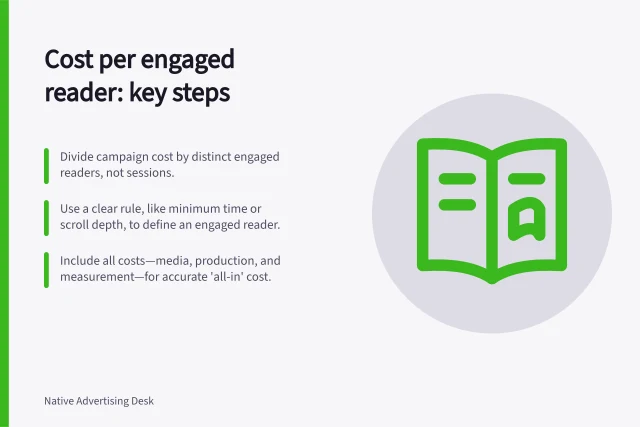
- Calculating cost per engaged readerDefine an engaged reader, match campaign costs to the same traffic, and calculate media-only and all-in costs without confusing users and sessions.
- Budgeting for content production and distribution separatelySet separate production and distribution lines, assess bundled quotes, and reforecast when a content change affects the media budget.
- Comparing publisher packages by deliverablesUse a common brief and deliverables table to compare creation, placement, promotion, rights, reporting and terms in publisher quotes.
- Setting a maximum acquisition cost for native trafficDerive an all-in acquisition ceiling from customer contribution, allow for production costs, and translate the remainder into a traffic limit.