Compliance
Part of Planning sponsored editorial content
Separating a sponsor's message from factual claims
Sort sponsor perspectives, product facts, comparisons and outcome claims before drafting a sponsored article.
A sponsor's message states the perspective it wants to convey. A factual claim says something readers could check. In the brief, mark that difference: the message can guide the angle, but it cannot prove a product fact, comparison or outcome.
Sort each statement
Read the sponsor's notes sentence by sentence. Consider the impression each statement would leave with a reasonable reader.
| Proposed material | Planning response |
|---|---|
| Point of view or priority | Attribute it to the sponsor and make its commercial role clear |
| Product fact | Check current documentation and material conditions |
| Comparison | Define the products, measure and period compared |
| Outcome or prediction | Ask for grounds and the conditions needed for the result |
| Wider context | Check it independently of the sponsor’s preferred conclusion |
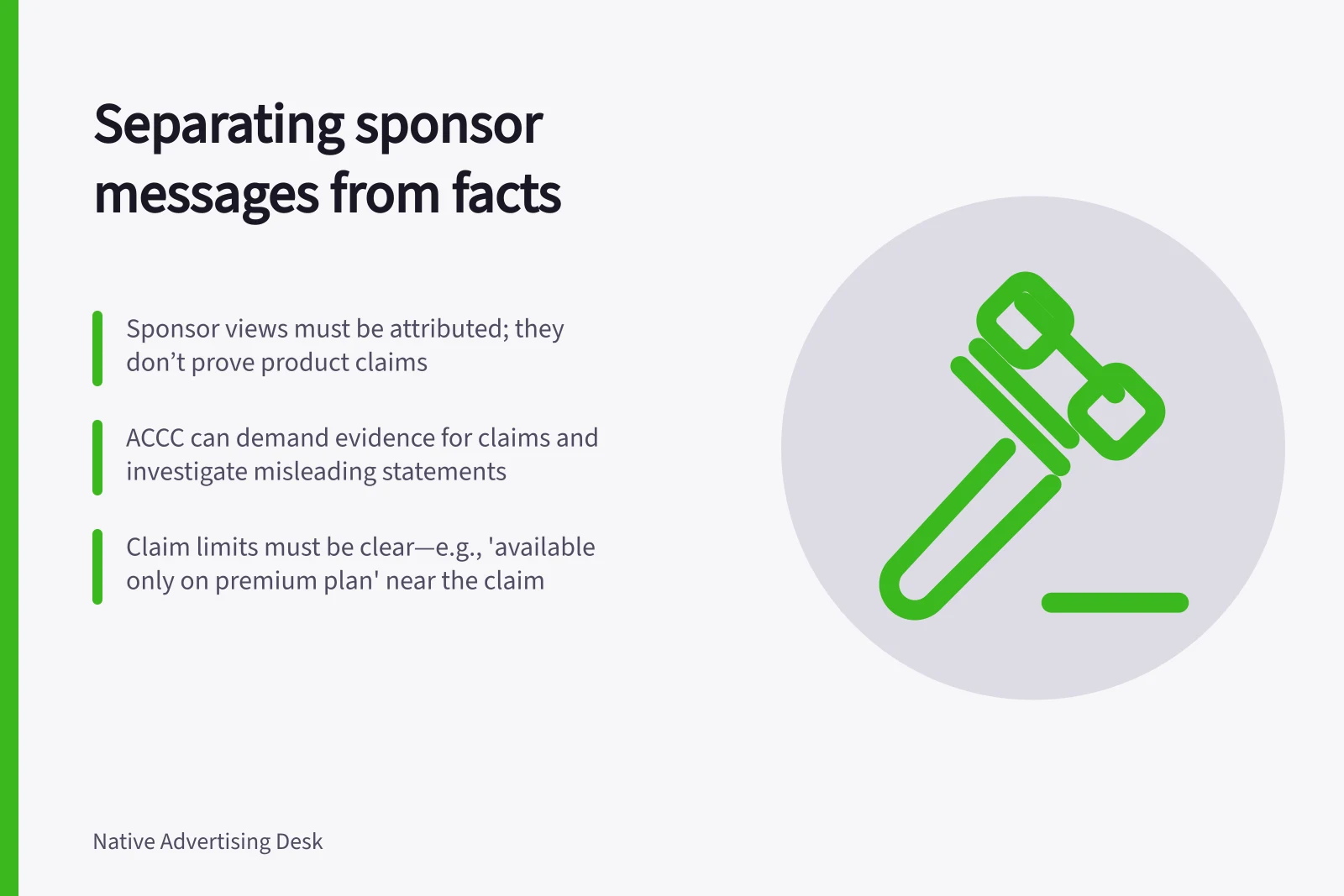
A sentence may fit more than one row. “We believe simpler onboarding matters” states a perspective. “Our service halves onboarding time” makes a measurable claim, even inside a quote or after “we believe”. Attribution does not make the number true.
Record the claim and its limits
For each material claim, record the proposed wording, the evidence supplied, its source and date, and the people or circumstances it covers. Draft wording that does not go beyond that evidence. A result from one customer group is not universal. A feature available only on a particular plan needs that condition near the claim.
The Australian Competition and Consumer Commission (ACCC) says it can require businesses to back up claims they make about their products or services, and can investigate if a business misleads. As a drafting check, review prominent wording alongside body copy. Make key conditions clear near the claim rather than relying on a footnote to convey them. Remove or narrow unsupported numbers and comparisons.
Key Regulatory Requirements for Sponsored Content
- ACCC Authority
- Can require businesses to substantiate claims.
- Misleading Claims Risk
- Businesses may face investigations or penalties if claims lack evidence.
- Disclosure Standard
- Sponsorship must be clear; facts cannot be disguised as opinion.
Keep perspective visible without disguising facts
A sponsored article can say the sponsor prioritises ease of setup. If it states a setup time, check the evidence and relevant conditions. The article may also need to mention a trade-off the sponsor would prefer to minimise. Consider whether leaving out a trade-off would change the reader's impression.
Identify every claim the proposed angle depends on. If a claim cannot be supported, change the angle before drafting. This planning pass decides what can responsibly enter production; it does not replace a full fact check.
Balancing Sponsor Perspective with Factual Accuracy
- ProsClear sponsorship disclosure maintains transparency. Presenting trade-offs builds reader trust and complies with ACCC guidelines.
- ConsOmitting trade-offs may mislead readers and risk regulatory action. Overstating claims without evidence can result in penalties under Australian consumer law.